CRM Data Cleansing: How Clean Contact Data Improves Customer Reachability

Content authorBy Claire ConnorPublished onReading time9 min read
A glossy smartphone in a human hand displays a dynamic interface filtering contact icons, surrounded by a warm, blurred bokeh background.

This article explains why mobile contact data quietly erodes inside a healthy-looking CRM and how CRM data cleansing keeps your messages landing. It focuses on mobile number quality as the most direct lever on whether a campaign or an OTP actually reaches the customer.

Why reachability quietly slips

You schedule the send. The campaign or the urgent service alert goes out to a list you trusted, and the delivery report comes back lighter than it should. A slice of those messages never reached anyone, because the mobile numbers behind them were wrong. The customers were real. The numbers were not.

That gap is hard to see from inside the CRM, which is what makes it dangerous. The record count looks healthy, and the database feels full. But a full database and a reachable one are different things. Contact data decays at roughly 30% per year as people change numbers and abandon lines, so even a well-run database loses the ability to reach customers without active maintenance.

The fix happens at the contact level, on the one field that decides whether a message arrives. The rest of this piece stays on the mobile number and what it takes to keep it clean.

What CRM data cleansing actually means

If you already run outbound messaging, you know your CRM. The trap is treating it as a project you finish once. CRM data cleansing is the ongoing process of finding and correcting contact records that are inaccurate or out of date, so the database stays usable rather than impressive. It is ongoing maintenance.

The distinction matters because the data never holds still. A database cleaned thoroughly today will have degraded meaningfully within three months if nothing maintains it, which is why a one-time cleanup always loses the race. The goal is recurring data hygiene as a default state, where clean records are the norm and decay gets caught as it happens.

Cleansing covers a lot of ground: removing duplicates, standardizing addresses, fixing email fields, merging conflicting records, and more. That full scope is a CRM administration and data-ops discipline, not something a single vendor or tool typically owns end to end. The mobile number field, which most directly governs whether a message gets through. On that mobile number specifically, ongoing validation is what separates a list that delivers from one that quietly fails.

How dirty mobile numbers break reach

Bad mobile data undermines outbound messaging in distinct ways, and each one has its own fix. Raw contact lists carry a heavy load of unusable numbers, with over 40% of B2B contact lists found to be invalid in one Cognism analysis. The point of breaking the problem into parts is to see the cost of each clearly enough to act on it.

Invalid and unreachable numbers

An invalid number fails before the message has a chance. The digit count is wrong, or the number cannot receive SMS at all because the entry was fake from a web form or the line was disconnected. Every one of those is a customer your message silently fails to reach, and you rarely find out until you check.

The cost compounds quietly. You pay the per-message send fee on numbers that were never going to deliver, and your failure rate climbs in a way that looks like a deliverability problem when it is really a data problem. Scrubbing landlines and VoIP lines from a list before a bulk send saves almost half of messaging budget. Better mobile data quality here is the difference between paying to reach customers and paying to reach nothing.

Validate every number. Deliver every message.

Talk to our team about real-time phone number validation, fraud prevention, and high-deliverability SMS for your business.

Outdated and recycled records

A number that was correct when you captured it goes stale on its own schedule. People port to new carriers and abandon old lines. Phone numbers decay at around 25% per year by Gemstone Data's estimate, which means outdated records are inevitable rather than a sign of sloppy entry. The 30% annual decay across your database includes these numbers going dark one by one.

Recycled numbers are worse, because the message still delivers, just to a stranger. Carriers reassign disconnected lines after a short cooling-off period, and the Federal Communications Commission estimates that around 35 million numbers are recycled in the U.S. each year. When a service alert or an order update lands on a recycled number, the new owner gets a message meant for someone else. The Identity Theft Resource Center found that 73% of people who received a recycled number got calls or messages intended for the previous owner. That erodes trust and exposes information you never meant to send.

Formatting and country code errors

Sometimes the customer is reachable and only the data is malformed. Bad formatting and a missing or wrong country code cause otherwise valid numbers to fail at send. The number is fine. The way it sits in your CRM is not.

The fix is to normalize numbers to a standard. E.164 is the international standard from the ITU that gives every number a single correct form, limited to digits and a maximum of fifteen of them, prefixed by the country code. A U.S. number like 415XXXXXXX becomes +1415XXXXXXX, which routes correctly across regions and integrates cleanly with any dialer or messaging platform. This is the easiest reachability gain you can make because you are fixing the data on customers you can already reach.

The cost of leaving it alone

The case for acting is easier to make when you translate these failures into numbers your stakeholders track. Poor data quality costs companies an estimated 15% to 25% of revenue each year, with marketing campaigns among the most exposed to wasted spend. When a meaningful share of a list never delivers, that budget is gone before a single customer engages.

Gartner research puts the average annual loss from dirty data at $12.9 million per organization, and most of that waste runs unmeasured. The harder-to-see costs sit in your messaging infrastructure:

  • Failed sends and high bounce rates degrade your sender reputation, and carriers respond by increasing filtering sensitivity on your traffic.

  • Unregistered or poorly behaved A2P traffic gets throttled or blocked, which means even your clean numbers deliver less reliably.

Then there is the operational cost that no dashboard shows you. A time-sensitive alert about a delivery or a security event that lands on an invalid or recycled number is a customer left in the dark. Customer reachability is the whole point of the channel, and dirty mobile data quietly takes it away one record at a time. Strong reachability is the difference between informing a customer and failing them when the message is urgent.

Validate every number. Deliver every message.

Talk to our team about real-time phone number validation, fraud prevention, and high-deliverability SMS for your business.

Scheduled versus real-time cleansing
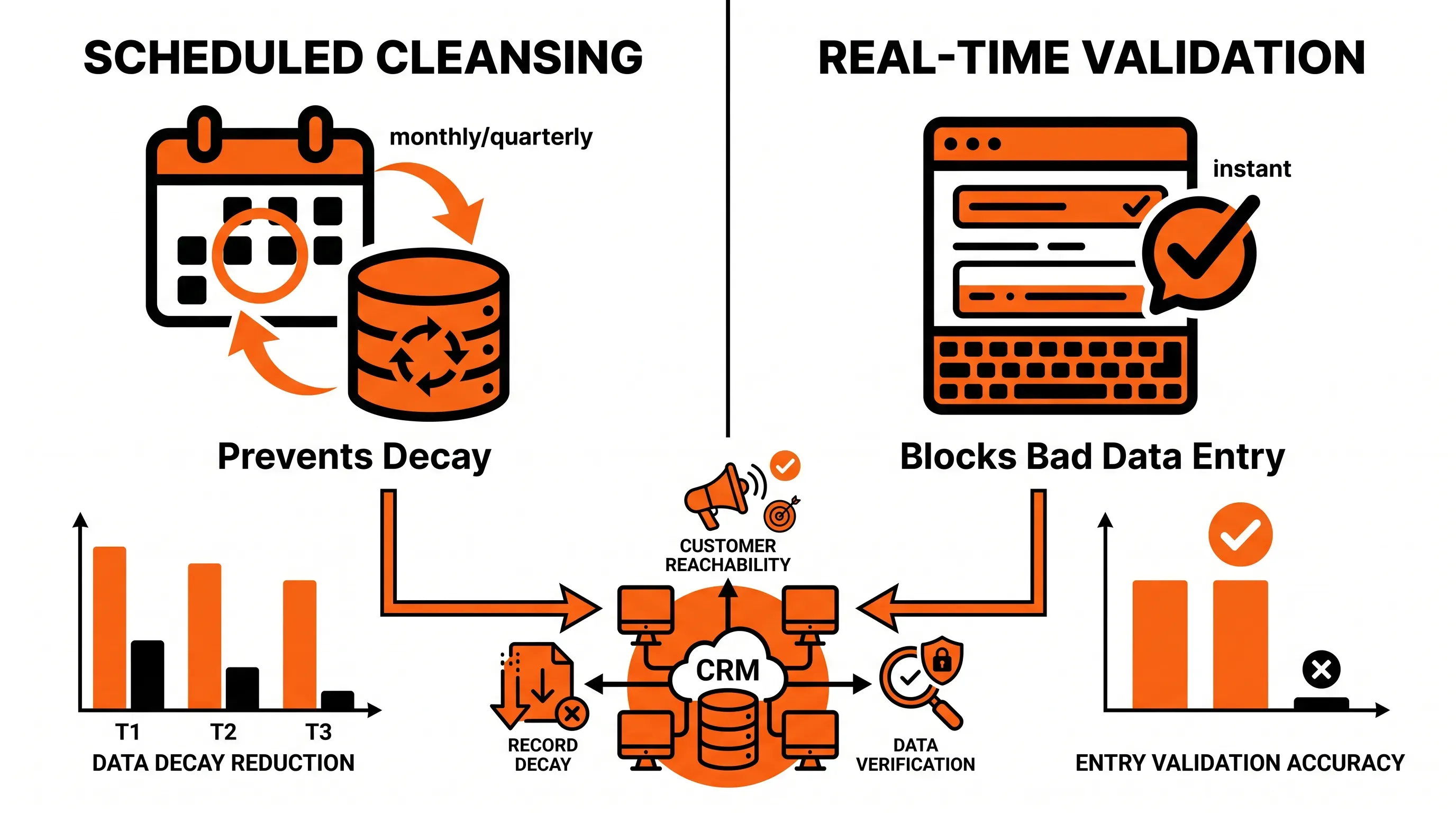
Bold infographic with orange and black icons for 'Scheduled Cleansing' and 'Real-Time Validation' on a white background.

There are two ways to keep mobile numbers clean, and the decision is about operationalizing hygiene rather than learning the concept. Scheduled cleansing runs in batches, monthly or quarterly, and passes over the existing database to catch numbers that have gone invalid or stale since the last check. Before a major send, you run a verification pass on the target list specifically, so the campaign goes out against numbers confirmed reachable rather than numbers confirmed last quarter.

Real-time validation works at the other end, at the point of entry. When a number is typed into a form or saved to a record, you check it then, so bad numbers never enter the CRM in the first place. This is where customer reachability gets protected before a single message is queued, because the record starts clean instead of needing a fix later.

The strongest programs run both, and the reason is structural. Real-time validation stops new errors at the door, while scheduled cleansing catches the decay that creeps into records you captured correctly months ago. One prevents the problem. The other manages the decay that no front-end check can stop, which is why keeping mobile numbers clean depends on having both in place. Run only one and you leave half the failure modes unaddressed.

Building recurring data hygiene

Treating mobile number quality as recurring infrastructure means giving it a cadence you can actually keep. A workable rhythm looks like this:

  1. Monthly spot checks on a sample of recent records and high-value segments, to catch entry errors and early decay before they spread.

  2. Quarterly deeper validation across the full database, since the 30% annual decay rate means a quarter is roughly when accuracy starts slipping in a way you can measure.

  3. Pre-campaign verification on the target list before any high-volume send, so the numbers are confirmed reachable at the moment they matter.

Ownership has to be explicit or the cadence drifts. CRM owns the records and the field definitions, while data ops owns the validation workflows and the batch jobs. Marketing owns the pre-send verification before campaigns. Without named owners, recurring hygiene work becomes everyone's job and therefore no one's.

Measure the payoff so you can defend the work. Track delivery rates and failure rates over time, and segment the results by how recently each list was validated. When pre-verified lists deliver consistently better than unverified ones, you have the evidence that recurring data hygiene pays for itself. That is the difference between an aspiration and a process, and it is what turns customer reachability into something you manage rather than hope for.

Clean numbers, better communication

The payoff is the thing you wanted from the start. Messages reach real customers, and send spend goes toward delivery instead of dead lines. Sender reputation stays intact, and operational alerts actually arrive. None of that holds on its own. Reachability is something you maintain continuously.

Broader CRM cleansing (deduplication, address standardization, email hygiene, and the rest) is work your CRM team or data-ops function typically owns directly. Where a specialist partner fits in is narrower and more specific: mobile number validation.

If you want to act on everything above, the practical next step is to validate your CRM mobile numbers before the next critical send. Acudo is a specialist mobile number validation partner that has worked with this data since 2005 and helps retail and fintech teams confirm whether numbers are real and active, with correct formatting, without the overhead of full CPaaS complexity. Speak to Acudo about validating your customer mobile numbers and about the workflows that keep recurring data hygiene running.


Validate every number. Deliver every message.

Talk to our team about real-time phone number validation, fraud prevention, and high-deliverability SMS for your business.

Check new or changed numbers at entry, then review active CRM lists before major sends. For ongoing crm data cleansing, use monthly checks on recent records and quarterly checks across the full database. This cadence catches entry errors and normal number decay before they affect campaign results.

You shouldn't delete invalid numbers automatically. Keep them with a clear status, validation date, and reason code, such as landline or disconnected. This preserves audit history and lets teams request an updated number through another verified channel.

Store the normalized number and the latest validation result. Keep the check date and line type as separate fields, so teams know whether the number is current and suitable for SMS. Avoid overwriting the original entry if your business needs audit records.

Yes, a valid mobile number can still fail to receive SMS. Delivery also depends on carrier filtering and sender registration. If failures rise on recently validated numbers, check messaging compliance and carrier response codes before blaming CRM data.

Acudo can validate the target mobile list before the send. The workflow checks number format and reachability signals, then returns results your team can use to suppress bad records or request updates. This helps reduce wasted SMS traffic while keeping the CRM record under your control.

Get in touch

Talk to our team about phone number validation, fraud prevention, and reliable SMS communications.

You Might Also Like

Discover more insights and articles

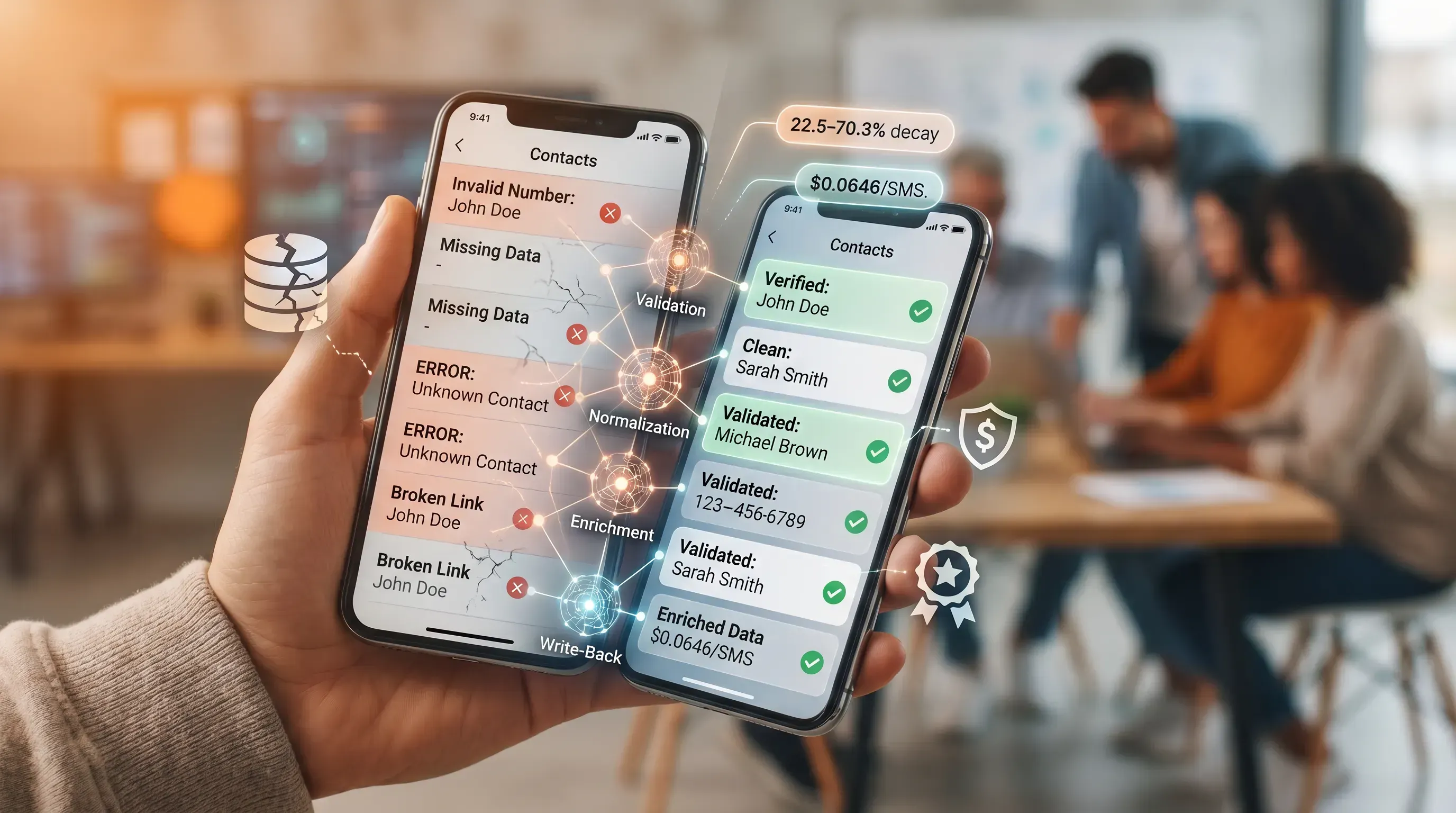
A human hand holds a glossy smartphone, showcasing a contact list transforming from messy to clean entries against a warm bokeh background.

Customer Phone Number Cleansing for Better SMS Campaign Readiness

This article explains customer database cleansing and shows how a practical pre-send cleanse protects SMS delivery and budget before a large campaign or seasonal peak.

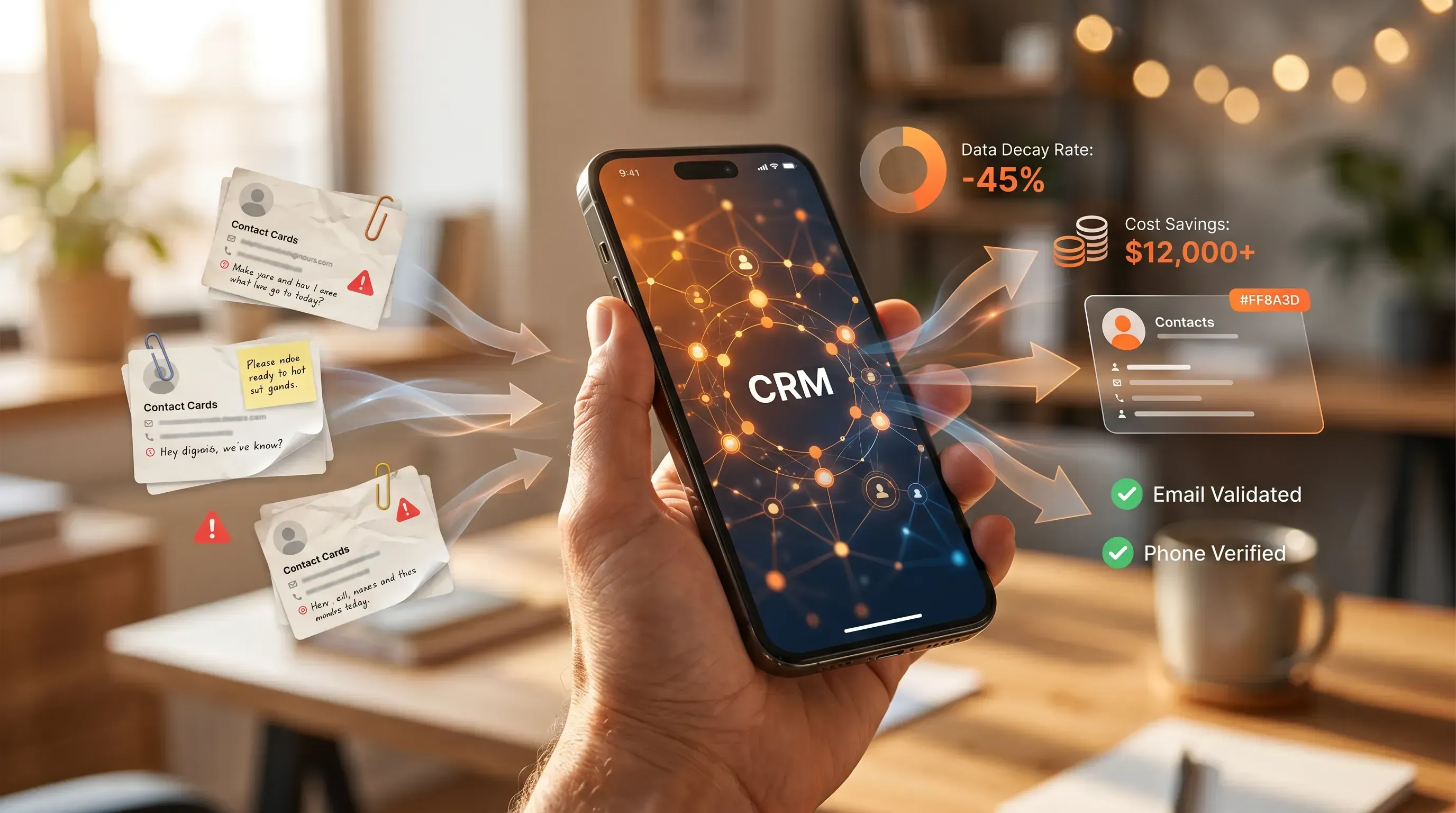
A hand holds a glossy smartphone displaying a dynamic CRM interface, surrounded by organized contact nodes and metrics in a warm office setting.

Customer Data Cleansing: Keep Contact Records Accurate Before You Message

This article treats customer data cleansing as an ongoing maintenance cycle that explains contact record decay and builds a repeatable routine around its costs so your messages keep reaching real people.

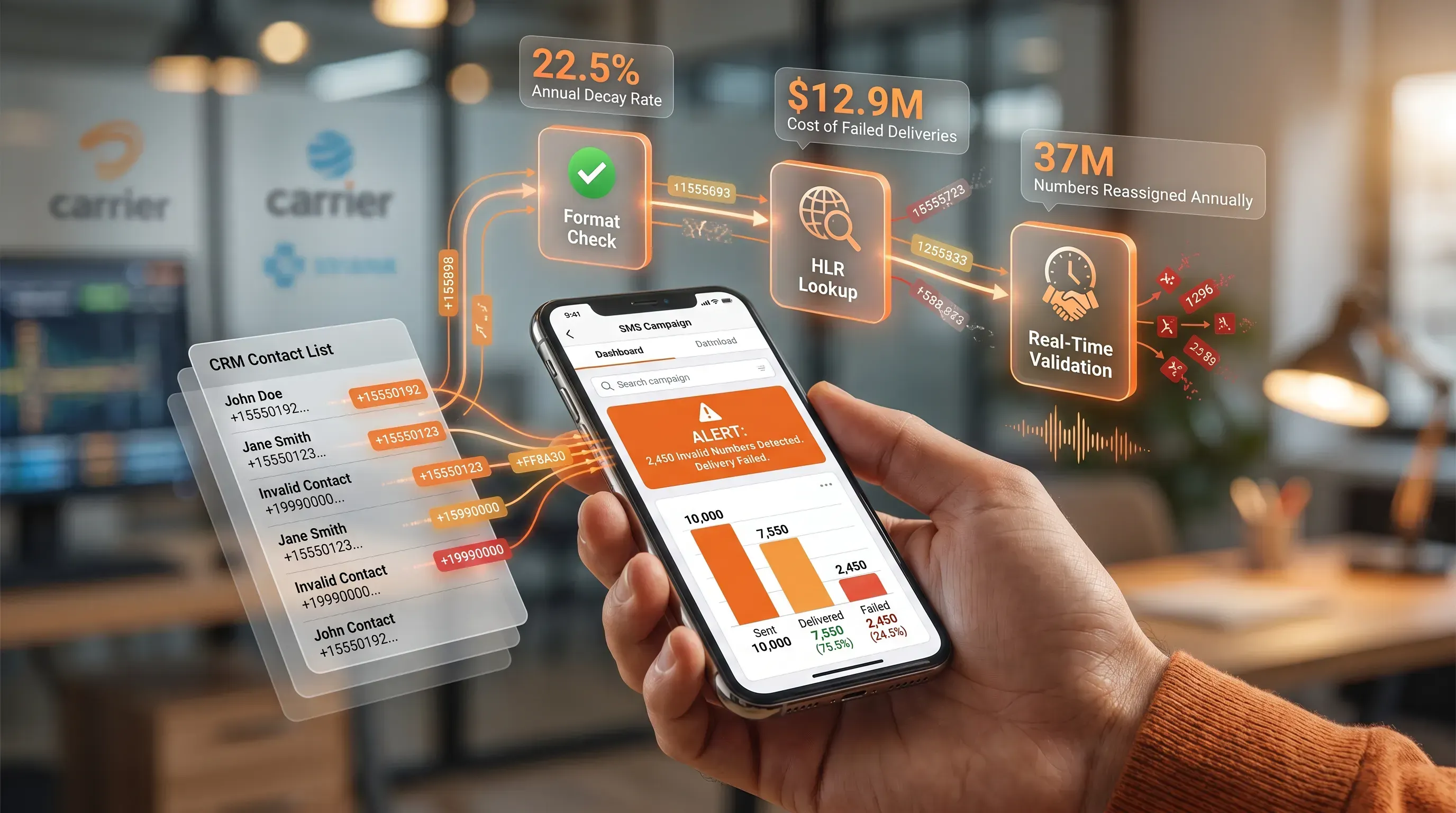
A realistic tech scene featuring a smartphone displaying an SMS campaign dashboard, with glowing validation nodes and a CRM contact list overlay.

CRM Phone Data Quality: Why Customer Phone Numbers Matter Before You Send

This article explains why CRM data quality shows up first in the phone number field and how that quiet decay drags down your SMS results. It also explains what to do about it. You will finish able to diagnose whether your own contact data is costing you reach and money through weaker delivery, and to make the case for fixing it.

A realistic hand holds a smartphone, surrounded by warm bokeh, with data icons streaming in and glowing contact nodes on the side.

Customer Phone Data Cleaning for More Reliable SMS Communication

This article explains why customer data cleaning is the real fix behind reliable SMS for order alerts and delivery updates. It walks through the data faults that make contact records go stale and break message delivery, then shows what a practical pre-send validation process looks like for ecommerce and operations teams.

Get in touch

Talk to our experts about validating phone numbers and delivering business-critical SMS with reliability and speed.

Close