Customer Phone Data Cleaning for More Reliable SMS Communication

Content authorBy Claire ConnorPublished onReading time11 min read
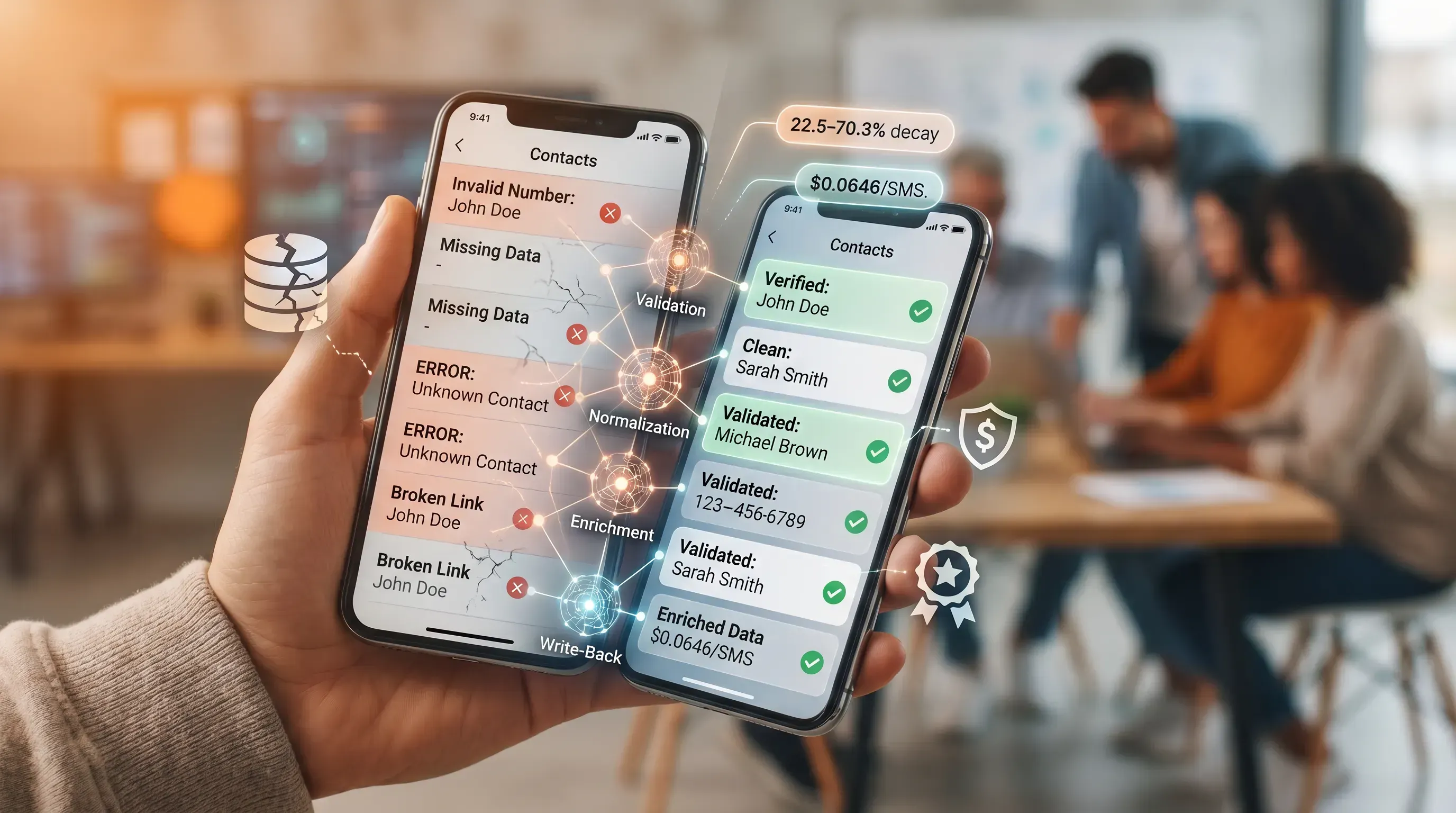
A realistic hand holds a smartphone, surrounded by warm bokeh, with data icons streaming in and glowing contact nodes on the side.

This article explains why customer data cleaning is the real fix behind reliable SMS for order alerts and delivery updates. It walks through the data faults that make contact records go stale and break message delivery, then shows what a practical pre-send validation process looks like for ecommerce and operations teams.

Why customer messages quietly fail

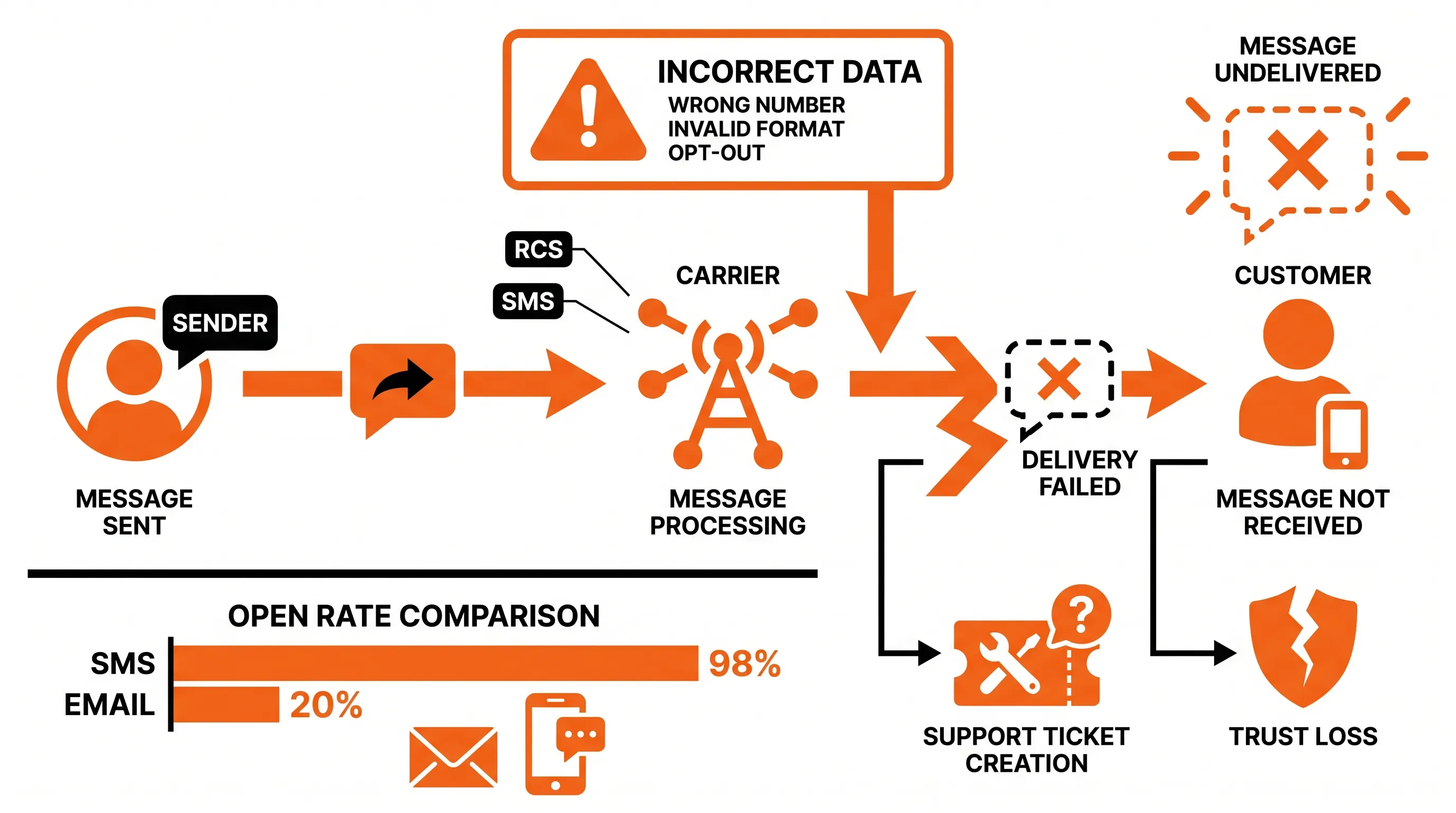
Bold vector infographic illustrating the customer message journey with icons, breakpoints for delivery failures, and SMS vs Email open rates.

You send the order confirmation. The delivery text goes out. And then a customer calls asking where their update is, because it never landed on their phone. Customer data cleaning starts with recognising that this issue often sist less with the message copy and more with the contact record behind it.

The message left your system. Your SMS dashboard shows it as "sent." But "sent" only means the message reached the carrier; phone-level delivery is a separate step documented in comparison of SMS and RCS delivery confirmation, which notes that SMS offers limited delivery confirmation and typically only tells the sender the message reached the network, not that it was seen. What sat between the two was a contact record that was wrong and no message copy, however well written, can compensate for a number that's unreachable in the first place.

That gap matters because SMS is the channel you lean on when timing counts. Text messages are opened at rates as high as 98%, far outpacing email's roughly 20% open rate, and consumers tend to check new texts within minutes of arrival.. So when a message fails, you don't just lose one send. You generate a support ticket for a message that went nowhere, and the customer's trust in your alerts erodes. The communication reliability you want comes from fixing the data behind the send.

How contact data goes stale

Contact data changes after you collect it. It decays continuously, and the pace surprises most teams who have never measured it. The figure you'll see across the data industry is that B2B contact databases decay at roughly 22.5% per year, and the monthly compound rate is about 2.1%. Some sectors run higher, with firmographic data at fast-changing companies going stale at 20 to 30% a year, according to Dun & Bradstreet.

Phone data specifically decays fast, and people change numbers often. A ten-year study in Uganda published in Scientific Reports found that 31.4% of participants switched at least one phone number between consecutive survey periods. Every switch quietly breaks a record you thought was fine.

The causes are a mix of human error and ordinary behaviour. Here's where the damage comes from:

  • A customer mistypes a digit at checkout, and the error sits undetected for months

  • Someone switches carrier or abandons a number, and the old one gets reassigned to a stranger

  • A landline gets entered into a field meant for a mobile

  • Numbers land in your database in a dozen different formats, some with country codes, some without

None of these announce themselves. Your list looks full and healthy right up until you send to it. If you manage a contact database but have never put a decay rate against it, the honest starting point is that a meaningful slice of it is already wrong today.

What breaks SMS reachability

When texts fail to reach customers, the causes are specific data faults. Each shows up differently in your send reports, so it helps to name them one at a time rather than lump them under "bad data."

Invalid and mistyped numbers

A single wrong digit is enough. A missing digit or a wrong country code turns a number into one the carrier can't route. These errors enter mostly at manual capture, when a customer or an agent types the number into a form, and they sit there quietly because nothing flags them at entry.

The cost is invisible until you look for it. You pay a message credit for each one, while the typo stays hidden. Against an industry benchmark where a 95% delivery rate or higher is the target, a batch of mistyped numbers drags you below it without any obvious cause you can point at.

Validate every number. Deliver every message.

Talk to our team about real-time phone number validation, fraud prevention, and high-deliverability SMS for your business.

Outdated and deactivated mobiles

Some numbers were correct when you captured them and have since gone dead. The customer switched carrier or disconnected the line, and the number was reassigned. These are the hardest to catch because they still look valid. The format and length are right, so the record looks clean.

Worse, a reassigned number now belongs to someone who never opted in. Your delivery update reaches a stranger who never asked to hear from you. It's worth separating these two failures clearly: a number can be perfectly valid and reachable and still not be permissioned for a campaign. Validation confirms a carrier can deliver to the number, but it says nothing about whether the current owner consented to hear from you. Contactability and consent are separate checks, and both need to clear before a marketing or regulated message goes out. Reassigned numbers is exactly where the decay rates bite, since the 15 to 19 changes per 100 person-years documented in that Scientific Reports study translate directly into records that pass a surface check but fail in the real world.

Landlines and VoIP in the list

Not every number can receive an SMS. Landlines and some Voice over Internet Protocol (VoIP) numbers get mixed into contact lists as though they were mobiles. They'll never deliver a text, no matter how many times you try.

Line-type detection sorts SMS-capable mobiles from numbers that will always fail. That filtering does two jobs at once. It stops you wasting message credits on numbers that can't receive anything, and it protects your sender reputation, because carriers watch how much of your traffic bounces and factor it into a sender "trust score" that determines whether your future messages get filtered or delivered.

The real cost of dirty data

Once you move from mechanics to money, the case for customer data cleaning gets easier to make to whoever holds the budget. Gartner estimates that poor data quality costs organisations an average of $12.9 million per year in wasted resources and lost opportunities. IBM has put the drain on the US economy at $3.1 trillion annually. Those are big numbers, but the mechanism inside your own operation is small and repeatable.

Every undeliverable number in a send costs you a credit and inflates your total send volume, which makes your reporting look busier than your actual reach. Your campaign analytics skew, because a delivery rate calculated against a dirty list tells you nothing reliable about engagement. And a rising bounce rate chips at your carrier sender reputation, which increases filtering sensitivity on the messages that would get through.

Then there's the human cost downstream. Each customer who never got a confirmation or an alert is a potential support ticket, and support time is the most expensive way to discover that your data was wrong. Gartner's own research has found that 60% of companies don't even measure what bad data costs them, which means this expense stays off most teams' reports.

Validate every number. Deliver every message.

Talk to our team about real-time phone number validation, fraud prevention, and high-deliverability SMS for your business.

Customer data cleaning before you send

The fix is a repeatable customer data cleaning pre-send workflow. Because data decays continuously, a single big scrub buys you a few clean months and then the rot resumes. A customer data cleaning process that runs before each significant send keeps the list honest as it degrades. Here's what the sequence looks like in practice.

Format and normalise records

The first step is to standardise every number into a consistent international format based on E.164, the ITU-T numbering plan for international public telecommunications. In practical CRM storage, that usually means saving the country code and national number in one canonical field, with a maximum of 15 digits excluding prefixes and presentation characters.

Normalisation alone catches a real share of failures before any lookup runs. When you convert everything to one format, the leading zeros and missing country codes surface immediately, because they break the pattern. This step needs a rule that says every number must end up in the same shape, and anything that can't be forced into that shape gets flagged.

Bulk validation and pre-send checks

With the list normalised, you validate it in bulk. This is where three distinct checks happen, and the difference between them matters:

  1. Format check, which confirms a number is structurally valid for the country or numbering plan

  2. Existence check, which confirms the number is real and active

  3. Reachability check, which runs carrier and line-type lookups to confirm a carrier will actually accept an SMS

A number can pass the first and still fail the third. It has the right format, but the line cannot receive SMS. These checks flag the undeliverable numbers before the send. The conservative move is to treat any unknown or flagged number as suspect and hold it back, because a single risky number protects your deliverability better than a hopeful send that damages your sender score.

Customer record cleanup and communication reliability

Validation only pays off if the results feed back into your database. This is the customer record cleanup step, where you update the numbers that changed and retire the dead ones so they never enter another send. Without this customer record cleanup loop, you re-clean the same faults every campaign and pay for the effort twice.

This is the step that turns a one-time scrub into durable communication reliability across every future send. And it's the cheaper path by a wide margin. Because contact data decays at 22.5% a year, proactive maintenance that trims the small monthly drift costs far less than the large recovery projects you'd run when a quarter of your list has quietly gone bad. Ongoing customer record cleanup is what keeps communication reliability from eroding between campaigns.

Operational wins of a clean list

The payoff lands in the metrics your team already watches. Filter out the invalid and mistyped numbers through customer data cleaning, and your delivery rate climbs back toward the 95% benchmark that signals a healthy list. Strip the landlines and dead mobiles, and your message spend drops because you stop paying to reach numbers that were never going to answer.

Your analytics get honest too. A delivery rate calculated against a validated list actually reflects reachability, which means the campaign decisions you make on top of it stand on solid ground. Cleaner traffic protects your sender reputation, since carriers see fewer bounces and keep delivering your future messages instead of throttling them. Registered senders on clean lists already run above a 90% delivery rate to the major carriers, and that headroom comes from the data.

The operational wins tie back to the specific faults that caused each problem:

  • Fewer support tickets, because the customers who used to miss alerts now receive them

  • Lower spend, because you stop buying credits for landlines and deactivated numbers

  • Cleaner reporting, because the denominator in your delivery math is real

  • A protected sender score, because your bounce rate stays low enough that carriers keep trusting you

The list is one connected argument. Each benefit is the direct reversal of a cost described earlier, which is why a clean list earns its keep.

Where to start with customer data cleaning

Start with an honest gut-check on your own list. When did you last remove a dead number instead of just adding new ones? Do you know your delivery rate per carrier, and has it drifted down over the past year? If your contacts sit in a dozen formats and nobody validates numbers at capture, your list is quietly working against you.

An in-house effort is enough when your list is small and you have the tooling to run carrier and line-type lookups. A specialist partner makes more sense when you're validating at scale or sending across borders where line-type rules differ by country. Acudo handles customer data cleaning by validating customer mobile data before your messages go out and separating reachable mobiles from numbers that break deliverability. To keep your SMS and OTPs where they should be, talk to Acudo about your customer data cleaning.

Validate every number. Deliver every message.

Talk to our team about real-time phone number validation, fraud prevention, and high-deliverability SMS for your business.

Check the phone data first. A sent status usually means the message reached a carrier, not the customer’s handset. Review invalid formats, landlines, deactivated mobiles, and carrier-specific failures before changing your SMS platform or rewriting message content.

Clean records before each large or time-sensitive SMS send. Contact data decays over time, so a quarterly or annual scrub leaves stale numbers in active campaigns. A pre-send customer data cleaning step keeps delivery reports closer to actual reachability.

Yes, validate numbers at checkout, account creation, and support intake. Real-time checks catch missing country codes, wrong lengths, and non-mobile numbers before they enter the database. This reduces later cleanup work and gives customers a chance to correct errors immediately.

Don’t delete every failed number automatically. Suppress numbers that fail reachability checks from SMS sends, then confirm the correct contact details through another channel when needed. Keep an audit field that records the failure reason and validation date for future review.

Yes, international SMS needs country-aware validation because numbering rules and mobile line types vary by market. E.164 formatting gives records a shared structure, but carrier and line-type checks still matter. Acudo helps businesses validate mobile numbers before sending critical communications across markets.

Get in touch

Talk to our team about phone number validation, fraud prevention, and reliable SMS communications.

You Might Also Like

Discover more insights and articles

A human hand holds a glossy smartphone, showcasing a contact list transforming from messy to clean entries against a warm bokeh background.

Customer Phone Number Cleansing for Better SMS Campaign Readiness

This article explains customer database cleansing and shows how a practical pre-send cleanse protects SMS delivery and budget before a large campaign or seasonal peak.

A hand holds a glossy smartphone displaying a dynamic CRM interface, surrounded by organized contact nodes and metrics in a warm office setting.

Customer Data Cleansing: Keep Contact Records Accurate Before You Message

This article treats customer data cleansing as an ongoing maintenance cycle that explains contact record decay and builds a repeatable routine around its costs so your messages keep reaching real people.

A realistic tech scene featuring a smartphone displaying an SMS campaign dashboard, with glowing validation nodes and a CRM contact list overlay.

CRM Phone Data Quality: Why Customer Phone Numbers Matter Before You Send

This article explains why CRM data quality shows up first in the phone number field and how that quiet decay drags down your SMS results. It also explains what to do about it. You will finish able to diagnose whether your own contact data is costing you reach and money through weaker delivery, and to make the case for fixing it.

A glossy smartphone in a human hand displays a dynamic interface filtering contact icons, surrounded by a warm, blurred bokeh background.

CRM Data Cleansing: How Clean Contact Data Improves Customer Reachability

This article explains why mobile contact data quietly erodes inside a healthy-looking CRM and how CRM data cleansing keeps your messages landing. It focuses on mobile number quality as the most direct lever on whether a campaign or an OTP actually reaches the customer.

Get in touch

Talk to our experts about validating phone numbers and delivering business-critical SMS with reliability and speed.

Close