Building a customer data cleansing routine
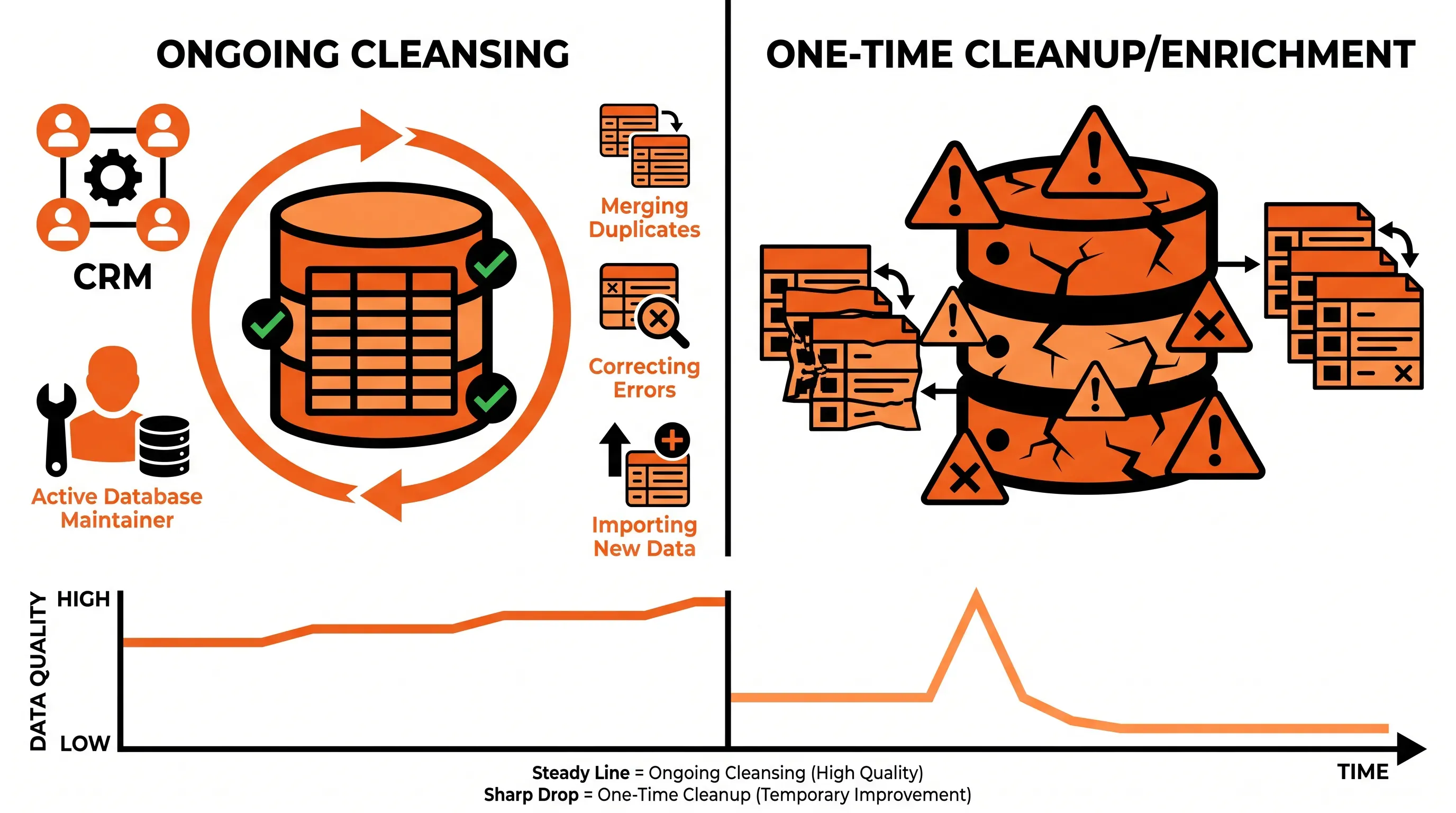
The fix is a standing routine that runs on a schedule, because the decay it counters runs on a schedule too. If you already operate a CRM daily, the point is to turn work you sometimes do into a workflow you always do. Customer data cleansing works when it's boring and repeatable.
A practical routine has a few moving parts that fit together:
-
Set data quality standards and consistent formats first, so numbers land in E.164 and fields follow one convention across every entry point. This stops new mess from arriving faster than you clean the old.
-
Audit your existing records against those standards to see where the gaps sit and how far the drift has spread.
-
Deduplicate and merge after you define clear rules for which record survives and which field values win before you process in batches.
-
Validate and correct contact details through checks that prove mobile numbers are active and reachable.
-
Assign clear ownership, because a routine with no owner quietly stops running.
That last step decides whether the whole thing holds. When cleansing belongs to everyone, it belongs to no one. Name the team or the role that owns data quality and make the cadence and metrics visible. Prevention is far cheaper than cure. The 1-10-100 rule holds that verifying a record at entry costs $1, while fixing it later costs $10. Doing nothing costs $100. A routine that catches problems at the door earns back its effort many times over.
Database hygiene and CRM refresh cycles
Database hygiene is the discipline of counteracting a decay rate that never pauses. If your data loses roughly a quarter of its accuracy a year, then a single annual scrub leaves you reachable in January and unreliable by autumn. The answer is a refresh cycle, a set cadence that keeps accurate contact records from slipping back into the state you just corrected.
Consistency beats occasional hypervigilance every time. A modest check that runs on schedule protects contactability better than an intense cleanup you do once and forget. The right cadence depends on two things: how large your database is and how fast your data changes. A high-turnover audience needs a tighter loop than a stable one.
-
Monthly suits active SMS programs and fast-moving lists, where waiting a quarter means sending to numbers that already went dead.
-
Quarterly fits most operational databases, which is the cadence Acudo recommends refreshing bulk validation results for active messaging.
-
Annual works only for low-volume, slow-changing records where the cost of a failed contact attempt is low.
Good database hygiene also includes point-of-entry validation alongside scheduled passes. A real-time check in front of your capture flows keeps bad records from ever landing, which protects accurate contact records between refreshes. The refresh cycle catches drift. Entry validation stops new drift arriving. Together they hold the line, and that combination is what sustainable database hygiene looks like in practice.
How clean data lifts messaging performance
Once records are reliable, the gains show up across every channel you run. Deliverability rises first, because you stop sending to dead addresses and dead numbers, which keeps your bounce rate low and your sender reputation intact. Pre-send validation reduces future bounce rates by 40 to 55% according to Opensend's benchmarks, and that protection compounds. Fewer bounces mean less throttling, which means even more of your good messages land.
More messages reach real people, so your OTPs and alerts actually complete their job. Service messages stop stalling on a wrong number too. Segmentation gets sharper too, because clean fields let you target the audience you meant to target rather than a padded version of it. Waste drops in step, since you stop spending on undeliverable sends. And your performance data finally means something, which lets you optimize against reality instead of against a distorted dashboard.
Clean data is the precondition for every messaging channel to perform. You can write the perfect OTP flow or the sharpest campaign, but if the underlying records are wrong, the effort dead-ends before it reaches anyone. Customer data cleansing is what connects the work you put into a message to the outcome you're measured on. Fix the data, and everything downstream starts behaving the way it was designed to.
Keep your contact data clean
Contactability is won before the send and held through a repeatable cycle. You now have a way to think about database hygiene as a standing operation: set standards and refresh on a cadence that matches how fast your data changes, with audit work built into the cycle before deduplication and validation. The payoff is measured in messages that reach real people and budget that stops leaking into dead sends.
If mobile reachability sits at the center of how you contact customers, speak to Acudo about mobile validation workflows. As a specialist partner, Acudo helps retail and ecommerce teams validate mobile numbers before critical communications go out, and it supports logistics and fintech teams with the same workflow so customer data cleansing stays focused on reachable, accurate contact records.