Hand holding a smartphone displaying a fintech transaction interface with glowing digital network connections and financial data visualization in a modern environment

Mobile Number Validation for Better SMS Reachability

This article explains what mobile number validation is and why it matters for any business that relies on SMS, OTPs, alerts, or service messages to reach customers. It explains which numbers are reachable and which are invalid or inactive, and shows how pre-send checks improve campaign performance and protect operational budgets.

Content authorBy Claire ConnorPublished onReading time11 min read

Why mobile reachability is a business problem

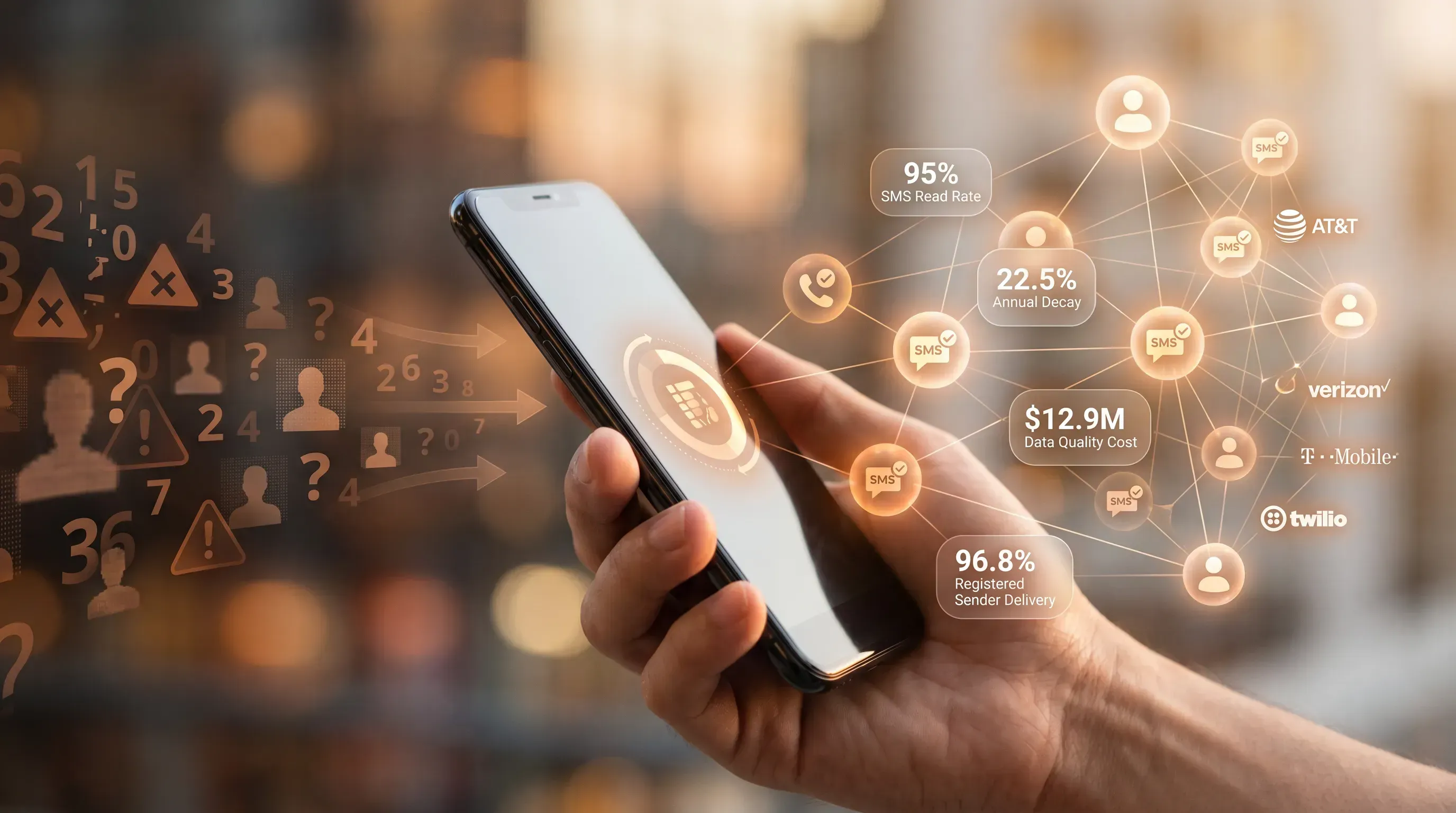
SMS is no longer a side channel. The global A2P SMS market was valued at $80 billion in 2024 and is on track to reach $104.5 billion by 2030, with authentication traffic the fastest-growing slice. Retailers push promotions, logistics teams send delivery alerts, banks dispatch one-time passwords, and CRM platforms fire renewal reminders, all through the same channel.

The trouble is that a meaningful share of those messages never lands. Industry reports cited by Fyno show that 10 to 15% of SMS OTPs never reach users due to carrier filtering and invalid numbers, with device issues also part of the problem. In China, Omnisend warns that unverified senders face roughly 70% failure rates as of April 2025. Every undelivered SMS is paid for and counted in your performance reports, even though the customer never saw it.

That creates real operational pain:

  • Wasted messaging spend on numbers that will never receive a message

  • Broken customer journeys when OTPs, delivery updates, or service alerts go silent

  • Inflated support volumes from customers who never got the code they were promised

  • Skewed analytics, because failed sends still pollute open and click metrics

Mobile reachability is a business metric. Treat it that way, and the conversation shifts from telecom plumbing to revenue protection.

What mobile number validation means

Mobile number validation is the process of checking, before you send anything, whether a number is correctly formatted and tied to a live mobile subscription capable of receiving an SMS. It goes further than confirming the digits look right. A proper check confirms the country code, the line type, the current carrier, and whether the SIM is active on the network at the moment of the lookup.

This matters because format checking alone creates a false sense of confidence. A number can comply with the ITU’s E.164 formatting standard and still be unusable due to issues like deactivation, number recycling, porting, or spoofing. Services such as e164.com help businesses turn raw phone numbers into actionable number intelligence by verifying formatting, checking whether a number is possible within a given country, identifying number type (mobile, landline, or VoIP), and detecting carrier and operator data commonly used in fraud prevention workflows.
To go further, Home Location Register (HLR) validation checks whether a number is actually active and reachable on a live mobile network. By using HLR Lookup, businesses confirm whether a number is valid, which network it currently belongs to, and whether it has been ported from another carrier. Using both tools together, e164 tidies the number and HLR Lookup checks the number. Acudo brings both together so businesses know which numbers they can trust before they send a message or make contact.

Using both tools together, Together, E.164 validation and HLR lookup give businesses a clearer picture of which phone numbers they can trust before sending messages or making contact.

This matters because format checking alone gives a false sense of safety. A number can parse cleanly against E.164 formatting rules published by the International Telecommunication Union and still be dead on arrival, with landline porting or recycled pool status hidden behind valid formatting. Services like e164 help close that gap by validating numbers against data from the Home Location Register, which is the live carrier record for every active mobile subscriber.

Ownership of this work sits with whoever owns the customer database. In retail and ecommerce, that's the CRM or marketing operations team. In fintech, it's risk and identity. In logistics, it's the operations group that runs delivery notifications. Mobile number validation is a data quality discipline, so it has to live with the team that already manages contact records day to day.

Types of numbers that hurt your campaigns

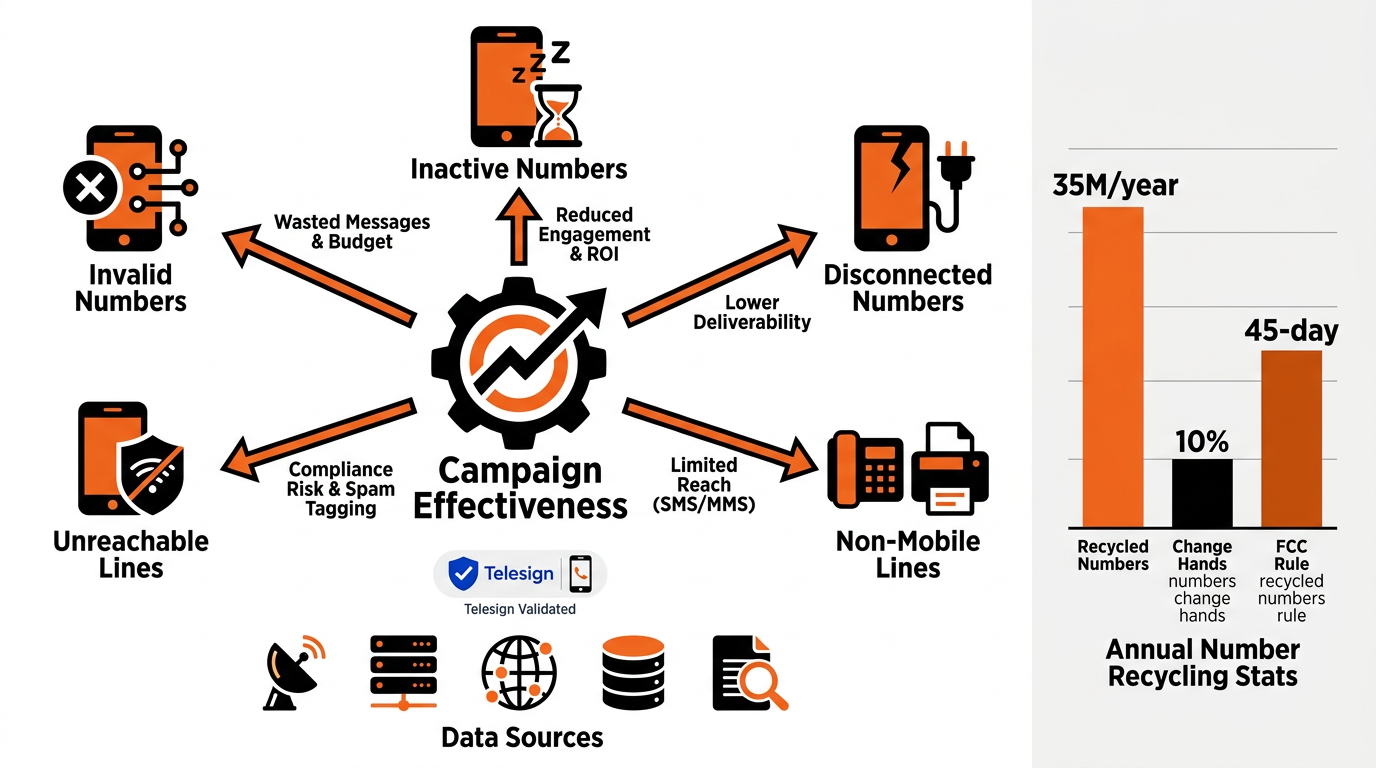
Bold infographic on a white background illustrating campaign effectiveness with clusters of icons and a sidebar bar chart.

Not every bad record fails for the same reason. Mobile number validation catches several distinct categories, and each one damages reachability and budget differently. Recognising which problem you're dealing with is the first step in fixing it.

Invalid numbers

These are numbers that are structurally broken. Wrong length, missing or incorrect country code, typos captured at a checkout, or prefixes that don't exist in the national numbering plan. They enter CRMs through web forms with weak field validation and through bulk imports from legacy spreadsheets where formatting was never standardised; contact centre agents under pressure add more errors.

Sending to an invalid number is a guaranteed waste. The message will be rejected at the gateway or accepted and silently dropped, and the cost is still on your invoice. Worse, these records distort delivery reporting because they get counted as attempts. Pre-send mobile number validation removes them before they ever hit the carrier, so the only numbers your platform processes are ones with a chance of arriving.

Inactive or disconnected numbers

These are well-formed numbers that were once valid and no longer are. The subscriber churned, ported away, or the SIM was disconnected and pushed back into the carrier pool. Telesign reports that around 35 million phone numbers are recycled each year in the US alone, which is nearly 10% of all US phone numbers changing hands annually.

Inactive numbers are dangerous precisely because they look fine. The database shows a clean entry. The send platform accepts it. But the SMS either fails silently or reaches a completely different person, which is a serious compliance and customer experience risk. In the US, the FCC mandates a 45-day aging period before reassignment, but that gap closes fast, and once a number is back in circulation, an OTP sent to it can give a stranger access to your customer's account.

Non-mobile and unreachable lines

Some numbers exist but can't receive SMS at all. Landlines, certain Voice over IP (VoIP) numbers, and lines in regions where the mobile termination path is blocked or filtered. A number captured in a call centre can be a desk phone the customer reads off without thinking. Line type detection sorts these out so you can route them to the right channel, voice or email.

For logistics teams sending dispatch updates, this is the difference between a driver reaching the right contact and an automated message hitting a deserted office line at 8pm.

How pre-send SMS checks improve mobile reachability

The traditional approach is to send first and read the delivery report afterwards. That's expensive because you've already paid the carrier, and slow because the next decision is based on stale data. Pre-send SMS checks flip the order. You validate the number first and route only reachable contacts into the campaign, then feed the results back into the CRM so the database improves with every cycle.

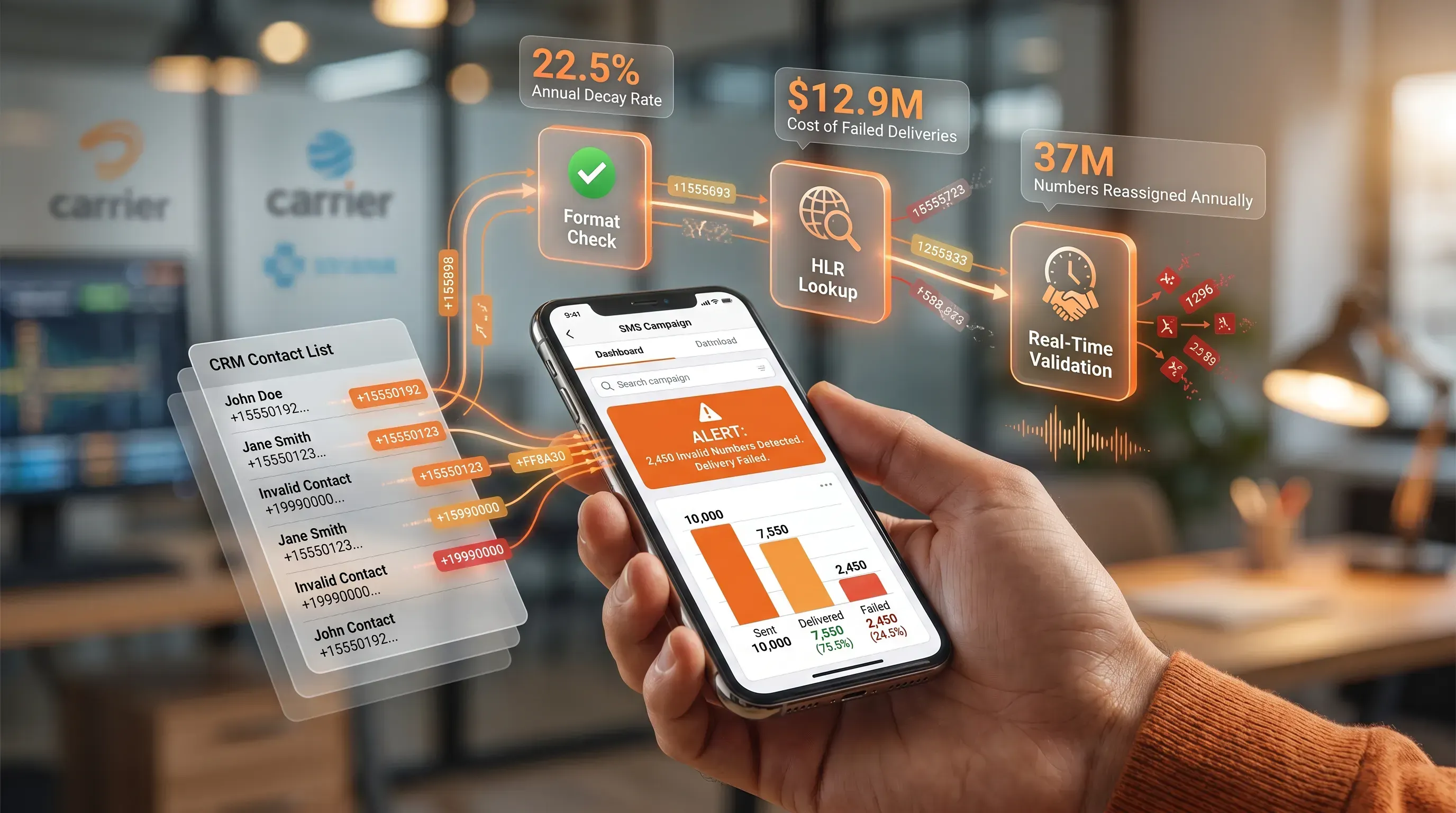
A pre-send workflow does four things in sequence:

  1. Parses and normalises every number to E.164 format

  2. Checks line type to separate mobiles from landlines and VoIP

  3. Queries the HLR for live status and current carrier, with porting history included in the lookup

  4. Returns a verdict your platform uses to include the record or keep it out of the send, with the record flagged where needed

The outcome is cleaner data going into the gateway. Sinch notes that a delivery rate above 90% is considered good, and clean lists are the most direct lever for getting there. Cost per delivered message drops because the denominator shrinks. Engagement metrics become honest because every send is a real attempt at a real handset. For operations and marketing leads, mobile reachability stops being a guess and starts being a measurable input.

Pre-send SMS checks also protect sender reputation. Carriers track sender behaviour and downgrade routes that consistently produce undeliverable traffic. If you keep firing at dead numbers, the good messages in the same batch suffer too.

Where validation fits in campaign preparation

Validation has to sit inside the rhythm your team already uses. Bolting it on as an afterthought before a big send turns it into a fire drill. Build it into the standing process.

There are four checkpoints where pre-send SMS checks pay back most:

  • Onboarding a new data source, such as a partner list or a refreshed loyalty database from an acquired brand

  • Refreshing dormant segments before reactivation campaigns, because contact data has aged silently while the segment sat idle

  • Pre-launch checks ahead of large promotions or service alerts where volume amplifies any waste

  • Real-time validation at point of capture, so bad numbers never enter the CRM in the first place

Transactional flows deserve special attention. For an OTP at checkout or login, one failed send is a lost conversion and, in fintech, a triggered support ticket. The MojoAuth team observes that for banking apps and fintech products where login is a high-frequency action, even a 5% failure rate at authentication is significant churn. Validating the number before the OTP is generated removes one of the largest preventable causes of that churn.

For marketing operations, the same logic holds at scale. With SMS pricing sitting between $0.01 and $0.05 per message, a million-record send with even 8% invalid contacts is hundreds of dollars wasted before the first delivery is logged. Treat mobile number validation as standing infrastructure.

Mobile data quality as an ongoing discipline

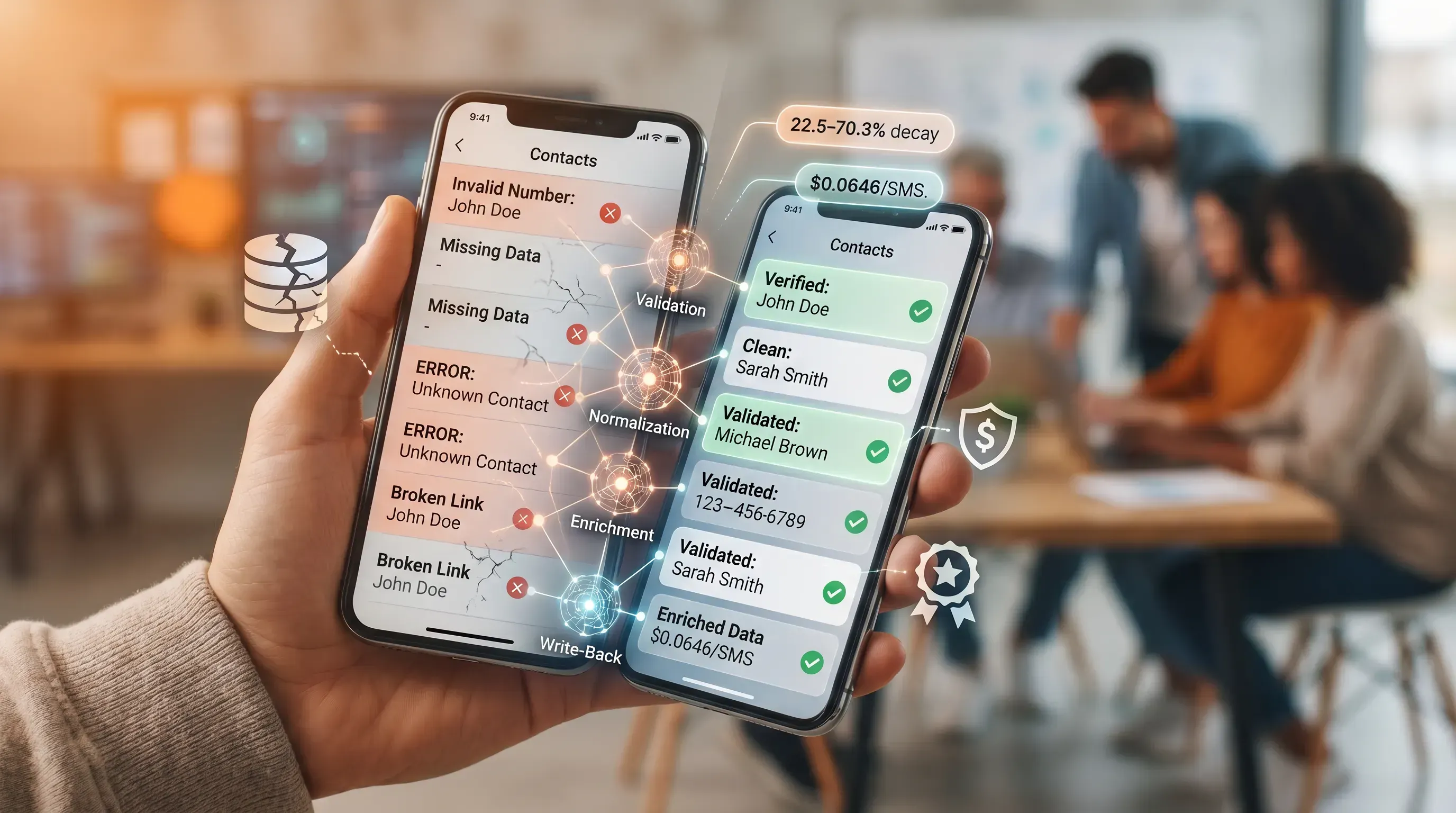
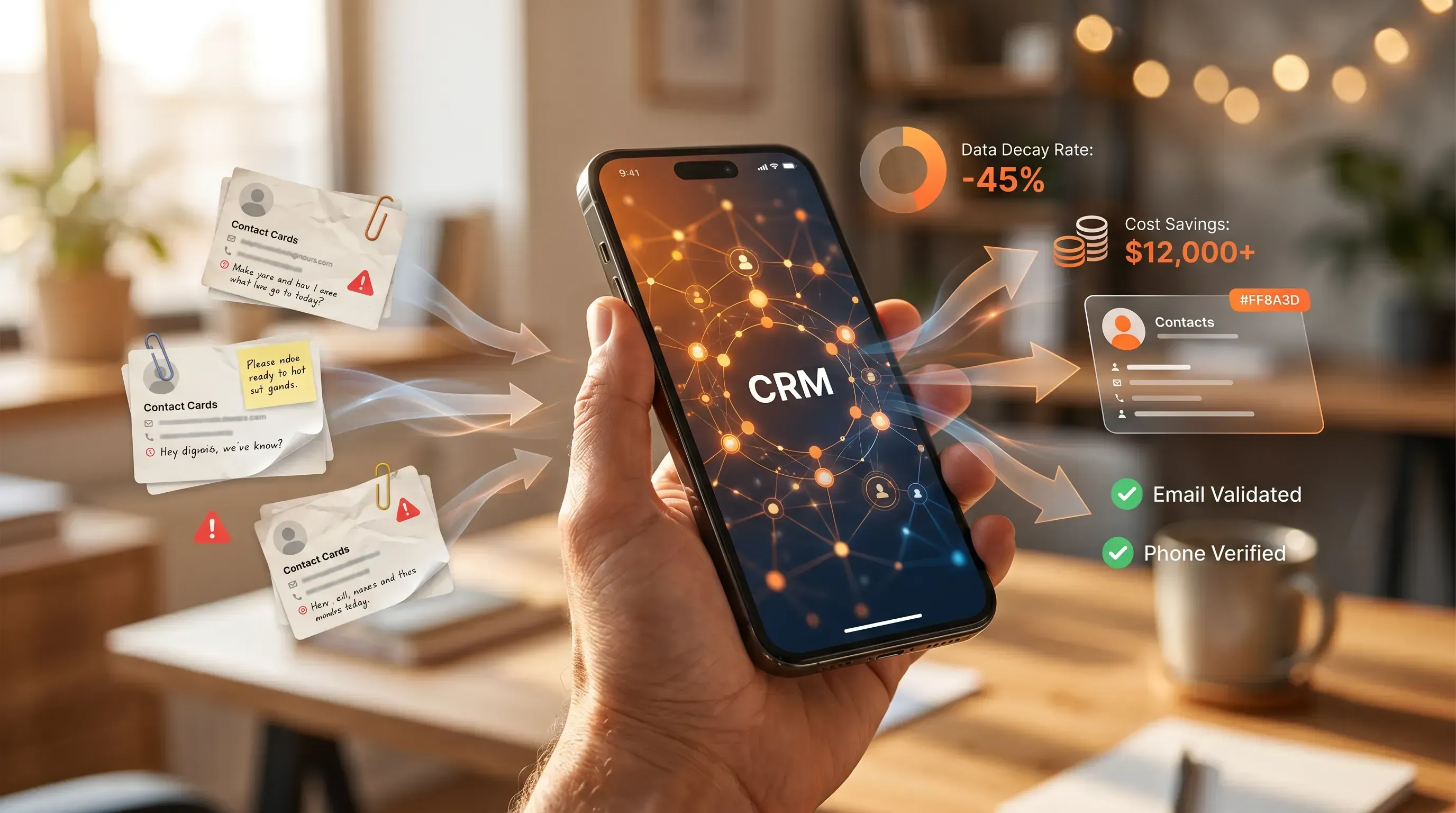
Customer contact data decays the moment it lands in your system. People change numbers, switch carriers, abandon SIMs after travel, and port between providers. Digital Applied's CRM Data Hygiene research puts contact data decay at 30% per year, and other studies tracked by Landbase show that B2B contact databases can decay by up to 70.3% annually in high-turnover sectors.

A one-off cleanse fades quickly because the next intake of records and the next round of recycled numbers immediately start eroding what you fixed, especially as subscribers churn. The fix is embedding mobile number validation at both ends of the lifecycle, when data enters the system and when it sits between sends.

This ties directly to broader business goals. Mobile reachability is a leading indicator for retention, because a customer you can't contact is a customer you lose. It's also a reporting issue, because executives looking at SMS conversion rates are reading numbers polluted by dead contacts. Validity's 2025 State of CRM Data Management report, summarised by Salesmotion, found that 37% of CRM users lost revenue directly due to poor data quality. Keeping the mobile data clean is one of the cheaper ways to stop that leak.

How Acudo supports mobile number validation

Most businesses don't want a full Communications Platform as a Service (CPaaS) stack just to clean their numbers. They already have a messaging vendor and a CRM inside an operations workflow. What they need is the validation layer that sits between the contact record and the send.

That's the slot Acudo fills. The platform validates numbers in bulk for campaign prep and in real time at point of capture, then returns results that feed straight back into a CRM or messaging stack. The underlying capability has been providing phone number intelligence since 2005, with developer-friendly APIs and batch uploads alongside ISO 27001 and ISO 9001 accreditation through GSMA membership.

The focus is narrow on purpose. Teams that already have a messaging provider keep it. Teams that want to add pre-send SMS checks to a checkout flow add an API call without rewiring their stack. The pitch is the validation layer, not a broader communications suite, so operations and marketing leads get cleaner mobile data without taking on a platform migration.

Talk to Acudo about your validation workflow

Cleaner mobile data reduces wasted sends and gives you higher delivery rates on the messages that count, with a CRM that reflects who you can actually reach. The payoff shows up on the invoice and in the conversion rates your team reports on Monday morning, with support ticket volume part of the same picture.

If SMS, OTPs, and service alerts are part of how you serve customers, mobile number validation belongs upstream of every send. Speak to Acudo about fitting validation into your existing workflows, whether that's a pre-launch check on a promotional list or a real-time API call at signup. The next step is a short conversation about your current send volumes and where the leaks are.

Store the normalized number and the latest reachability status. Add the validation date plus a reason code, such as inactive or landline, so your CRM can suppress bad records and decide when to recheck a contact. Keep the original entry only if your audit process needs it.

Recheck numbers before each high-volume SMS send and after a contact has been dormant for 90 to 180 days. For login or payment flows, validate at capture and refresh status before high-value service messages. Number changes and carrier moves happen constantly, so old checks lose value.

No, validation confirms reachability and line status, not personal ownership. To prove the user controls the number, use an OTP or another verification step after validation. This split matters because a recycled number can be reachable even when it no longer belongs to the customer in your CRM.

Validation reduces avoidable delivery failures, but it can't guarantee that carriers will accept every message. Filtering also depends on sender registration and message content. Local rules affect it too. Use validation to remove unreachable numbers first, then review carrier requirements if delivery problems continue.

Acudo sits between the CRM and the SMS platform, returning validation results before a send or at signup. The client can keep its current messaging vendor while adding checks that flag unreachable records. Speak to Acudo about mobile validation workflows if you need this layer.

Schedule a Meeting

Book a time that works best for you