Valid Phone Number Check: What Businesses Need to Know Before Messaging

Content authorBy Claire ConnorPublished onReading time9 min read
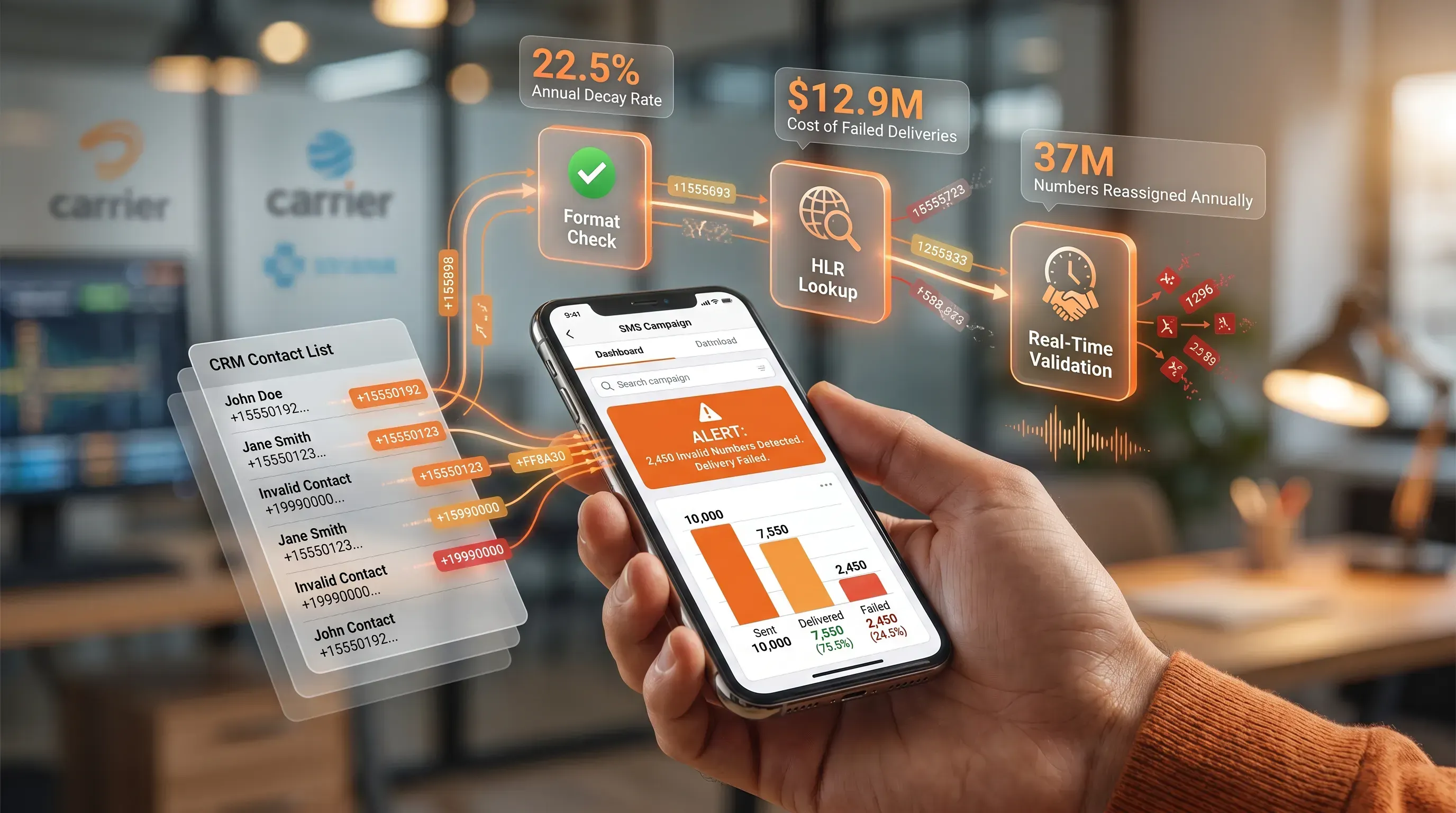
sms-campaign-analytics-dashboard-phone-number-validation.png

This article explains what happens inside a phone validation step and where to slot it into the customer lifecycle. It's written for CRM, ecommerce, operations, and engagement teams who depend on contact data that actually works when a campaign goes out.

Why phone number quality matters before you send

Every undelivered SMS is paid for twice: once at send, and again in the engagement metrics that get skewed by failed traffic. A valid phone number check upfront reduces that loss by removing numbers that will never reach an inbox. If your provider charges per segment and a chunk of your list is unreachable, you're funding messages that can't convert.

There's also a deliverability tax. Mailchimp's deliverability guidance is direct on this point: sending to invalid or recycled numbers raises bounce rates and signals poor data quality to carriers, which then filter or throttle future traffic. Sender reputation behaves like a credit score. Once it dips, even well-formed messages to good numbers start landing late or not at all.

The data itself doesn't sit still either. IndustrySelect research, aggregated by Landbase, puts B2B contact decay at roughly 2.1% per month, or about 22.5% per year. At the same time, the FCC created the Reassigned Numbers Database specifically because reassigned numbers create compliance and consent risks under the Telephone Consumer Protection Act (TCPA).

Most customer databases hold checkout-form typos and stale account numbers from lines that have been ported or reassigned. A valid phone number check upfront prevents most of the waste those records create.

What a valid phone number check actually does

A valid phone number check is a stack of checks, and each check answers a different question. The first asks whether the digits make sense. The second asks whether those digits are tied to a real subscriber line. The third asks whether that line is actually reachable right now.

The layers build on each other. A number can pass the first and fail the second. It can pass the first two and still fail the third. The order matters because each layer is more expensive and more informative than the one before. Treat them as a pipeline of progressive checks.

The three layers below give you the mental model for the rest of this guide. Format is the starting point, while usability and reachability form the spine of any serious valid phone number check.

Format validity

Format validation confirms that a number conforms to the E.164 international numbering plan published by the International Telecommunication Union. E.164 caps a number at 15 digits with the full country-code-to-subscriber-number structure and no spaces or punctuation.

Tools like e164 help catch typos and missing country codes, but say nothing about whether the number exists. For example, the string +14150000000 passes a format check because it has 11 digits and a valid country code, yet no carrier has assigned that subscriber number.

Validate every number. Deliver every message.

Talk to our team about real-time phone number validation, fraud prevention, and high-deliverability SMS for your business.

Usable numbers

The next layer asks whether the number is actually in service and what kind of line it is. This is where Home Location Register (HLR) lookups come in. An HLR query goes to the mobile network operator's subscriber database and returns the current carrier, line type, ported status, and whether the number is roaming. Tata Communications describes it as a real-time check on whether the number is active or ported.

Tools like HLR Lookup help determine whether the number can receive an SMS. Many VoIP numbers, for example, are not configured for short-code SMS at all.

Usability checks also feed pre-send validation logic. If you know a line is a landline, you route a voice call. If it's a confirmed mobile, SMS stays on the table. The lookup pays for itself by routing the message to a channel the recipient can actually use.

Reachable numbers

Reachability is the deepest layer and the one that actually predicts deliverability. It confirms whether the number is currently active on the network and able to receive a message right now. The signals include ported status, disconnected state, temporary unavailability such as a powered-off handset, and roaming flags.

Reachability isn't static. A number verified a month ago may no longer be active or reachable today.

Why a number can look valid but still fail

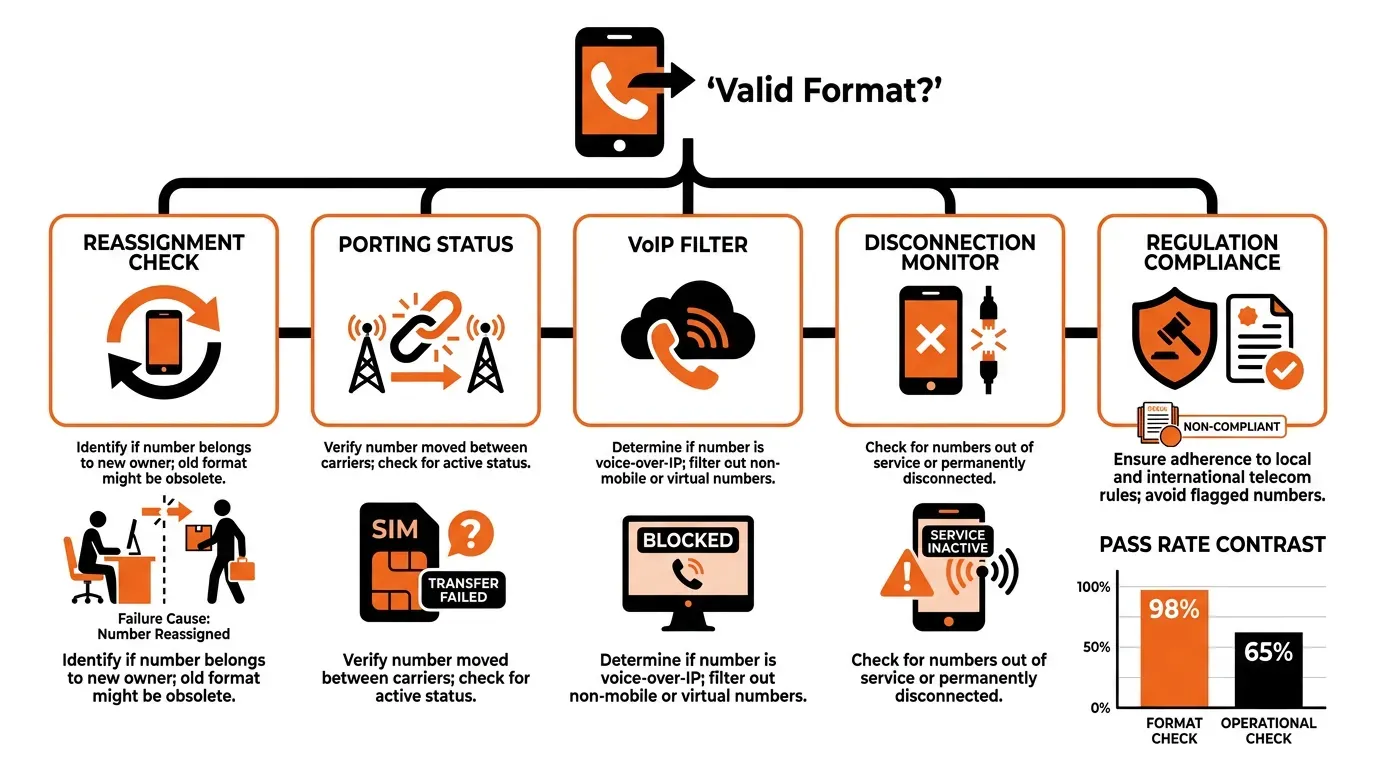
Bold flat SaaS infographic on a white background featuring a phone number icon and five checkpoints with icons and text blocks.

A well-formed number can fail in production for reasons that have nothing to do with how it's written. The most common ones cluster around five patterns:

  • Reassigned numbers, where the original consenting subscriber gave up the line and a new person now holds it.

  • Ported numbers where routing tables in older CRMs still point to the original carrier.

  • Disconnected lines that look active in your database but have been retired by the carrier.

  • VoIP numbers that platforms or carriers block from receiving SMS, particularly two-factor codes.

  • Country-specific quirks like national trunk prefixes or do-not-disturb registries.

Reassignment is the legal landmine. The FCC's Reassigned Numbers Database has been operational since November 2021, and it exists because calls to reassigned numbers can trigger liability under the Telephone Consumer Protection Act.

VoIP filtering is the silent killer of OTP flows. Platforms like WhatsApp, Instagram, Telegram, and Gmail run submitted numbers through carrier lookup APIs to detect VoIP because those numbers are cheap to generate in bulk and disproportionately tied to fake signups. A format check won't catch any of this. Only a layered valid phone number check that includes line type and carrier metadata will.

When to run number checks in the customer lifecycle

A valid phone number check is an operational practice attached to specific moments where it pays off the most. Three of those moments do the heavy lifting.

At point of capture

Running pre-send validation during signup, checkout, or onboarding allows customers to correct invalid numbers before inaccurate records enter the CRM. Asking "Did you mean +44 7700 900000?" might seem small, but the cost of a poisoned CRM record is high because that record will follow you through campaign segments and attribution reports afterwards.

Pre-send validation doubles as a fraud signal as well. A submitted number that resolves to a known disposable VoIP range is a useful early flag for fake accounts, particularly in ecommerce and fintech onboarding. Catching the bad record at the form is cheaper than removing it from a segment two years later.

Validate every number. Deliver every message.

Talk to our team about real-time phone number validation, fraud prevention, and high-deliverability SMS for your business.

Before campaign sends for wasted message reduction

The second high-value moment is a batch check across a segment immediately before an SMS campaign goes out. The goal is to reduce wasted messages by stripping out numbers that will not deliver. Carrier and messaging providers consistently recommend validating recipient data before sending high-volume traffic because failed delivery attempts still consume operational and messaging resources.

Reducing wasted messages is especially important on large promotional sends and reactivation campaigns, where the share of stale numbers is highest.

During periodic database hygiene

The third moment is scheduled. Quarterly batch validation across the full customer base catches numbers that have gone stale. Run it before major seasonal campaigns when the cost of a bad list is highest.

Database hygiene also keeps the CRM trustworthy as a source for other systems. Attribution models and lifecycle automation both read from the same contact records. Periodic validation prevents the bad data from spreading into reports that operations teams rely on.

How validation supports cleaner customer records

Deliverability is the headline benefit, but the downstream effects of a valid phone number check are broader. Validated numbers carry metadata: line type, carrier, country, ported status, roaming flag. That metadata enriches the customer profile and feeds routing decisions across channels.

Knowing a contact's line type tells you whether SMS or a voice call is the right path. Knowing the carrier helps with country-specific routing and least-cost selection on transactional traffic. Knowing the ported status flags records that need a refresh on the next hygiene run. None of that is available from a format check alone.

A valid phone number check also improves segmentation accuracy. Duplicate records hide behind small format differences, like one number stored as +14155551234 and another as 415-555-1234. Normalising both to E.164 collapses the duplicate. Cleaner segments mean cleaner attribution, which means the marketing team isn't arguing with finance about why the numbers don't match.

Building number checks into your workflow

The practical question is where to plug validation into the stack. Three placements cover most cases:

  1. An API call at point of capture that returns a verdict in real time so the form can prompt for correction.

  2. A batch process before campaign sends, where an exported segment is validated before bad records are suppressed on re-import.

  3. A scheduled job on the CRM itself that refreshes line type and reachability metadata on a cadence that matches your decay rate.

Latency is the main constraint at point of capture. A real-time check has to return in a few hundred milliseconds or the form starts feeling slow. Batch jobs have looser latency budgets but tighter cost budgets, because you're paying per lookup across tens or hundreds of thousands of records. Continuous API-based validation workflows help maintain cleaner customer records without requiring manual list-cleaning processes.

Failure handling matters too. If the validation service is down, don't block signups. Accept the number provisionally and re-validate when the service recovers. Hard-failing a checkout because a lookup API is slow is worse than admitting a slightly noisy record.

Talk to Acudo about checking your numbers

A valid phone number check is the cheapest piece of insurance you can buy for an SMS programm. It cuts wasted SMS spend and protects sender reputation while the CRM stays clean and reliable for other systems. The savings show up immediately on the next campaign, and the data quality compounds from there.

Acudo helps CRM and ecommerce teams validate customer numbers before important communications go out. Whether you need real-time checks at point of capture or batch validation ahead of a campaign, talk to our team about wiring pre-send validation into your stack so wasted message reduction becomes the standard.

Validate every number. Deliver every message.

Talk to our team about real-time phone number validation, fraud prevention, and high-deliverability SMS for your business.

Recheck active customer numbers at least quarterly if SMS is a core channel. Phone data changes every month through reassignment, porting, and disconnection, so a yearly cleanup leaves stale records in campaigns for too long. High-risk flows, such as OTPs or payment reminders, need validation closer to the send time.

Treat a failed number according to the failure reason, rather than deleting every record. Suppress disconnected and landline numbers from SMS, route landlines to voice if consent allows, and ask the customer to update details at the next login or checkout. Keep the validation result in your CRM for audit and routing.

No, phone validation doesn't prove consent. It confirms number format, line type, carrier data, or reachability, depending on the checks used. Consent still needs its own record, including when the person opted in, what they agreed to receive, and the source form or transaction.

Neither is better for every use case. Real-time validation works best when the customer can correct a typo on the page, while batch validation fits campaign prep and CRM hygiene. Teams that send critical messages often use both, with a valid phone number check at capture and before large sends.

Use validation rules that explain the issue and let the customer correct it. Don't block signup for temporary lookup failures or unclear reachability results. Acudo can help teams set practical fallback rules, such as accepting the number provisionally and rechecking it before the first important message.

Get in touch

Talk to our team about phone number validation, fraud prevention, and reliable SMS communications.

You Might Also Like

Discover more insights and articles

A human hand holds a glossy smartphone, showcasing a contact list transforming from messy to clean entries against a warm bokeh background.

Customer Phone Number Cleansing for Better SMS Campaign Readiness

This article explains customer database cleansing and shows how a practical pre-send cleanse protects SMS delivery and budget before a large campaign or seasonal peak.

A hand holds a glossy smartphone displaying a dynamic CRM interface, surrounded by organized contact nodes and metrics in a warm office setting.

Customer Data Cleansing: Keep Contact Records Accurate Before You Message

This article treats customer data cleansing as an ongoing maintenance cycle that explains contact record decay and builds a repeatable routine around its costs so your messages keep reaching real people.

A realistic tech scene featuring a smartphone displaying an SMS campaign dashboard, with glowing validation nodes and a CRM contact list overlay.

CRM Phone Data Quality: Why Customer Phone Numbers Matter Before You Send

This article explains why CRM data quality shows up first in the phone number field and how that quiet decay drags down your SMS results. It also explains what to do about it. You will finish able to diagnose whether your own contact data is costing you reach and money through weaker delivery, and to make the case for fixing it.

A realistic hand holds a smartphone, surrounded by warm bokeh, with data icons streaming in and glowing contact nodes on the side.

Customer Phone Data Cleaning for More Reliable SMS Communication

This article explains why customer data cleaning is the real fix behind reliable SMS for order alerts and delivery updates. It walks through the data faults that make contact records go stale and break message delivery, then shows what a practical pre-send validation process looks like for ecommerce and operations teams.

Get in touch

Talk to our experts about validating phone numbers and delivering business-critical SMS with reliability and speed.

Close