Mobile Phone Number Validation for Cleaner Customer Communication

Content authorBy Claire ConnorPublished onReading time10 min read
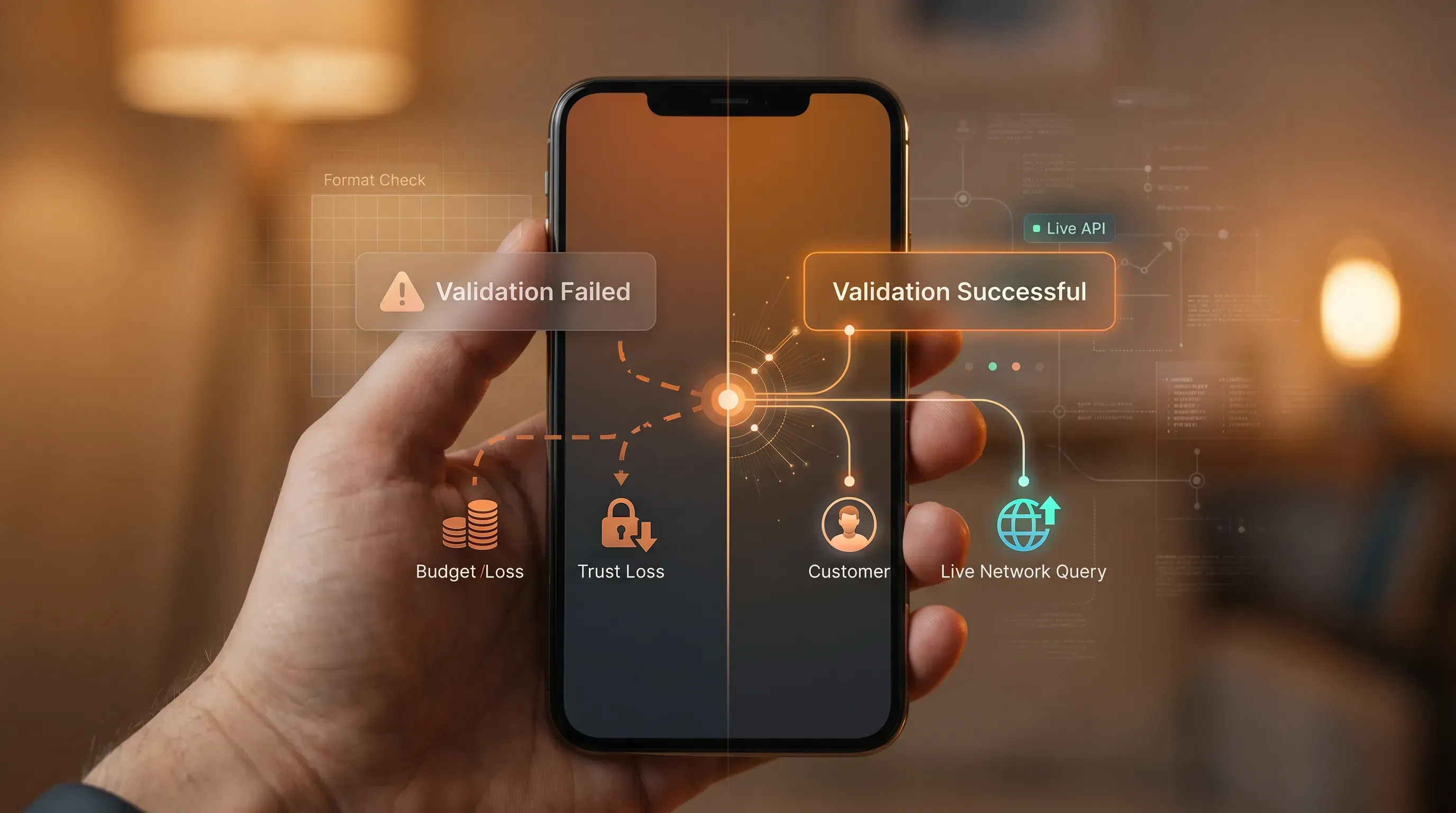
A lifelike hand holds a smartphone displaying a split screen: one side shows a failed validation message, the other a success.

This article explains mobile phone number validation as a practical data quality step and shows where a mobile number validation API fits for the teams who depend on reaching customers by mobile every day. It walks through what validation checks, when to run it, and how to choose between a quick format check and a live network query so you can decide where it fits in your stack.

Why mobile numbers fail you

You send the campaign. The dashboard says it went out. And yet a slice of your customers never see the message you sent, from order updates to security codes. The number was on file, but the message had nowhere to land. That gap between having a number and that number being reachable is where budget and trust quietly leak out.

Mobile records rot from the moment they enter your system. A customer fat-fingers a digit at checkout. Another swaps carriers and ports the line. Someone enters a landline into a field your form treats as mobile. Over time these errors stack up, and the decay is faster than most teams assume. Gartner has historically cited that up to 30% of CRM data becomes inaccurate annually, which means more than a quarter of your direct numbers can go stale before you notice.

The reason it stays hidden is the wording in your own reports. "Sent" doesn't guarantee delivery to the recipient's phone. A failed send and a successful one can look identical in a campaign summary. So the problem rarely shows up where you'd look for it, and that's exactly what a mobile number validation service helps fix. The rest of this article unpacks how.

What a mobile number validation workflow checks

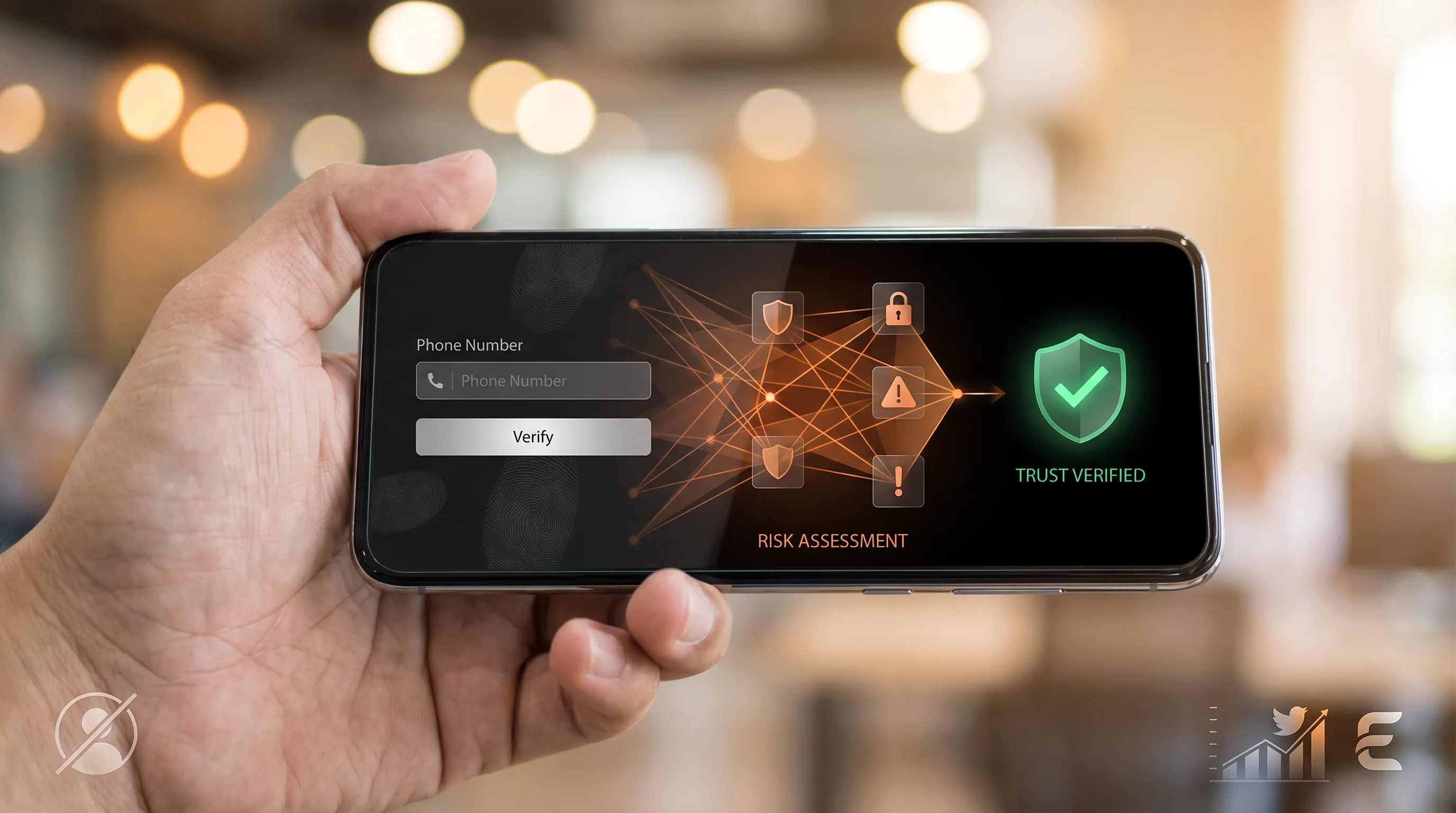
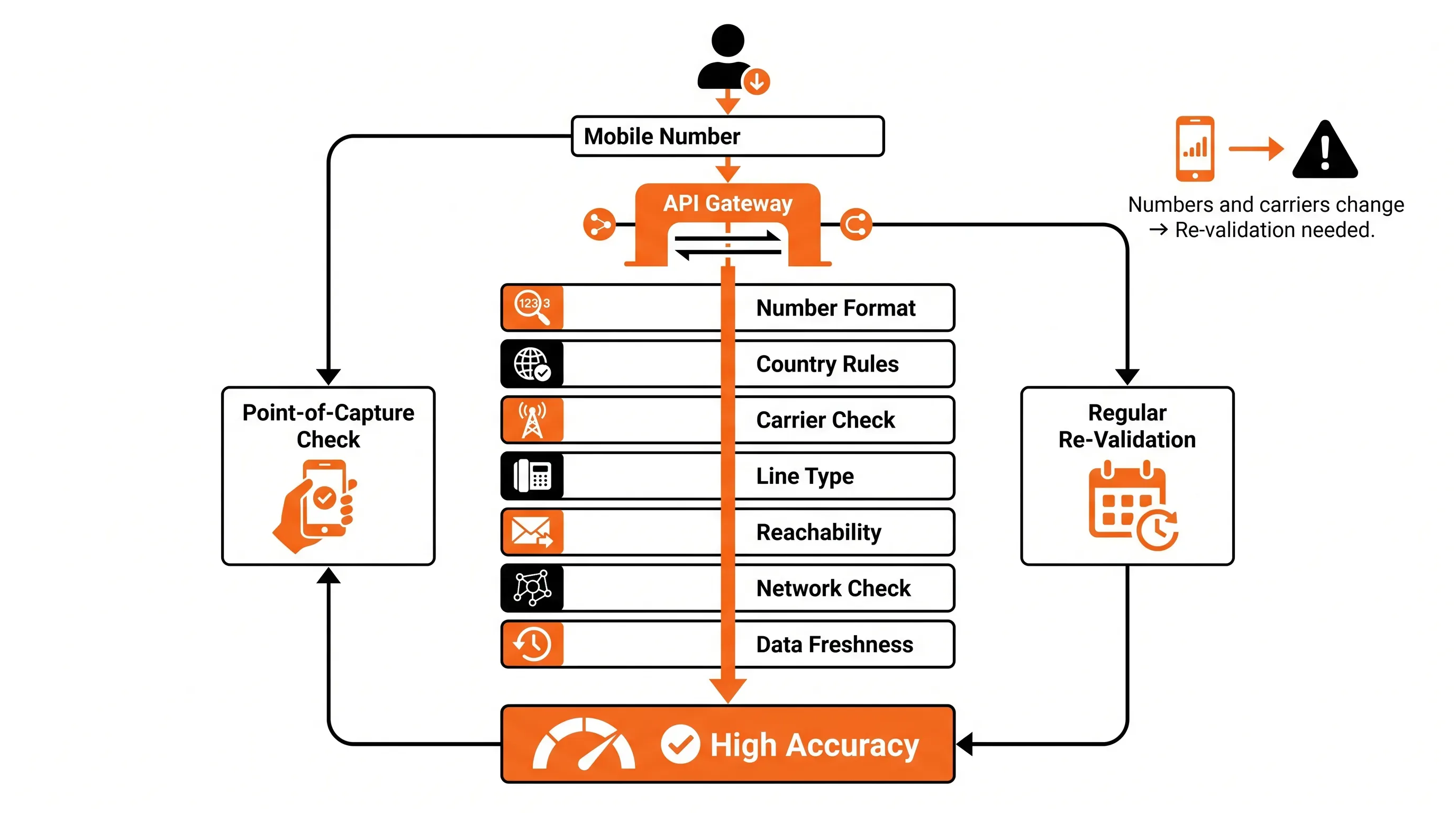
Bold infographic illustrating a user entering a mobile number, passing through validation layers, with a focus on accuracy and re-validation.

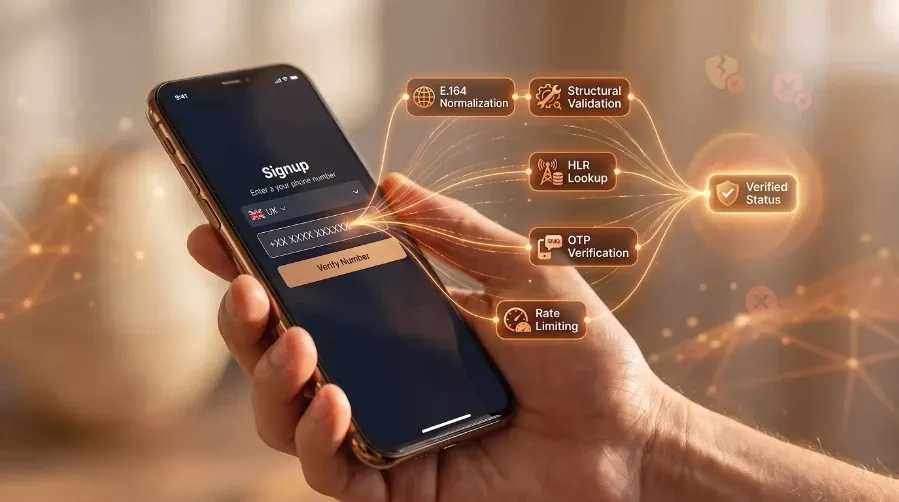
When you run a number through a mobile number validation API, you're asking a layered question: is this number shaped correctly under its country's rules, and is there a live handset on the other end right now? Each layer answers something different, and you don't always need all of them.

A mobile number validation API response gives you fields you can act on directly. The check returns whether the number is valid or invalid, its country and carrier, the line type (mobile, landline, or Voice over Internet Protocol), and whether the line is currently reachable.

The two checking approaches below do different jobs. One is fast, cheap and belongs at the point of capture: it tells you a number was valid at that moment, not that it will still be valid when you send. Numbers go out of use. Carriers change. A customer who gave you a real number at signup may no longer be on it by the time your campaign fires. That's why point-of-capture checks and a regular re-validation cadence before sends work together rather than one replacing the other.

The other check talks to the network and tells you what's actually true right now. Choosing between them is the practical decision a validation API puts in your hands.

Format and numbering plan checks

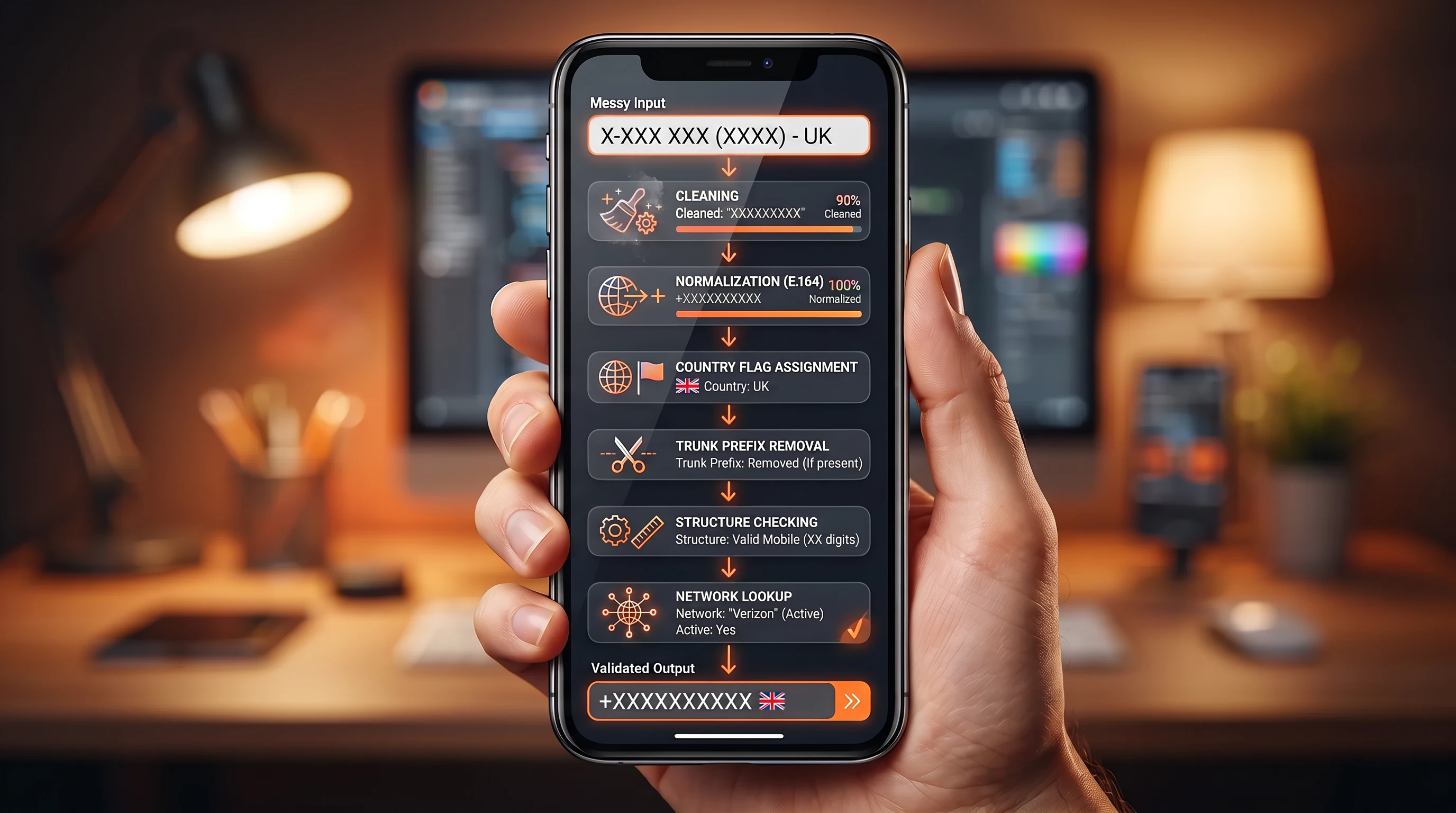
The lighter layer confirms a number is built correctly. It checks that the digits follow the country's numbering plan, that nothing is missing, and it standardizes the result to E.164, the international format defined by ITU-T Recommendation E.164 that caps a number at fifteen digits and prefixes it with a country code. A UK mobile entered as 07XXX XXXXXX comes back as +447XXXXXXXXXX, ready to send.

This catches badly shaped numbers instantly and at no cost, which is why it fits capture-time use at a signup form or checkout. It's the cheapest way to stop bad data at the door.

Its limit matters, though. A format check confirms a number is structurally valid. It can't tell you the line is live, or even that it's a mobile rather than a landline. For that you need the deeper check.

Validate every number. Deliver every message.

Talk to our team about real-time phone number validation, fraud prevention, and high-deliverability SMS for your business.

Live network checks and HLR lookup

An HLR lookup queries the Home Location Register, the mobile network's own subscriber database, in real time. A live network lookup checks the number against mobile network data and returns a network-level status: whether the number is active, reachable, ported, or associated with a mobile line. It also surfaces roaming status and line type. That makes it a meaningful confidence signal before sending, but it should be treated as a point-in-time validation, not a permanent guarantee. A number confirmed active today may not be in use next month.

There's a lighter cousin worth knowing. A portability database check, also called an MNP lookup, identifies the current carrier of a ported number without a live network query. Unlike a static portability database, an HLR lookup returns live connectivity, which is the difference between knowing who owns a line and knowing the line works.

The trade-off is cost against certainty. Format validation alone catches roughly 70 to 80 percent of bad numbers, the cheap and obvious ones. A live HLR lookup pushes accuracy far higher because it weeds out disconnected and non-mobile lines that pass a format check cleanly.

For low-risk, high-volume capture checks, format validation is sufficient: it catches the obvious errors quickly and cheaply. For high-value sends, such as one-time passcodes or transactional alerts where a missed message has a direct cost, use live network validation to confirm the line is active before you commit the send.

When to validate your numbers

A mobile number validation API supports validation as a recurring data quality step at three points in your workflow, and the right method changes with your location in the process.

  • At the point of capture: run a lightweight format and numbering plan check on the form or checkout to stop bad data entering in the first place. It's instant and cheap, so it never slows the customer down.

  • On existing records: cleanse your CRM periodically because numbers decay whether you touch them or not. A live HLR lookup here finds the lines that have gone dead since you last checked.

  • Before a send: run a pre-send pass on a campaign or operational batch, with the depth of check that matches the stakes.

The logic is simple once you map it onto your own stack. Lightweight checks live at the form, where speed matters and volume is high. Deeper network checks live in front of high-stakes sends, where a missed message costs you a customer or a failed transaction. Batch validator at least twice a year, because numbers that were active at capture change over time.

Validate every number. Deliver every message.

Talk to our team about real-time phone number validation, fraud prevention, and high-deliverability SMS for your business.

Bulk cleaning vs real-time checks

Two operational modes cover almost everything these teams run, and they serve different needs. Knowing which is which keeps you from over-engineering a simple form or under-protecting a critical send.

Bulk validation cleans an existing list or prepares a large campaign send. You export records and run the file before you import the status fields back into your CRM. Acudo's own batch process takes a full file at scales of millions of rows and returns a structured verdict on whether to keep the record or suppress it for re-collection. Scheduled batches and cached results matter here because they stop you paying to recheck the same record twice in a short window.

Real-time validation runs at onboarding or checkout, where a check completes in milliseconds and the customer never feels it. The request goes out as the number is typed, and the response comes back before the page moves on. This is a request-response service, as Acudo describes its mobile number validation API, that talks to network registries instead of guessing from the shape of the digits.

So the split is clean. Bulk mode is for list hygiene and big sends. Real-time mode is for live capture, where friction is the enemy. Most teams end up running both, and a single phone validation tool built around an API can serve each mode without forcing you to choose one forever.

The cost of wasted sends

Here's the commercial case in plain numbers. Every invalid mobile record you send to burns message credit and distorts the failure reporting your team is judged on. A campaign that looks like it reached 100,000 people but actually reached 78,000 tells you a story about engagement that isn't true and wastes spend.

There's a reputation cost too. Rising SMS bounce rate damages your sender reputation, and carriers respond by filtering more of your traffic. So the dead numbers drag down delivery for the good numbers in the same send.

The teams named at the start of this piece feel it in different ways:

  • Fintech onboarding stalls when an OTP never arrives. SP 800-63B guidelines discuss OTP delivery risks over SMS.

  • Logistics delivery alerts don't land, so the customer waits at the wrong time and the support line lights up.

  • Ecommerce promotions miss the people they were meant for. Every wasted send is return left on the table.

Cleaning numbers before they hit the queue protects both the budget and the integrity of the metrics you report on. An API that runs ahead of the send is the difference between a number you hope works and one you know does.

How validation improves customer experience

Cost is one half of the story. The half your CX and operations teams care about most is whether the customer ever feels let down, and contactability sits underneath that.

When messages such as order updates and security codes reliably arrive, the customer trusts the channel and stops calling in to ask where their message is. That's a direct cut to inbound support load. SMS earns this trust because it gets read: the channel sees high open rates, but only if the number underneath is real and reachable in the first place.

There's a quieter benefit at signup. A real-time check catches a mistyped number while the customer is still on the page and can fix it, instead of letting the error surface days later when a delivery alert vanishes into nowhere. Landlines cannot receive a text, quietly drain a list until a phone validation tool flags them. An HLR lookup confirms the line is a live mobile before that friction ever reaches the customer.

Which brings the through-line back into focus. A number on file only helps if it can be reached. A number validation API is what closes the gap between those two states, and it does it before the customer ever notices there was a gap.

Getting started with cleaner data

Turning this into action is a short sequence. Use a lightweight format check at capture, then use a live HLR lookup for bulk CRM cleanup and pre-send passes on the batches that matter. The depth of check should match the stakes of the send. Integration into a CRM or existing workflow is straightforward because a phone validation tool runs through an API that returns status fields you import straight back into your records.

Acudo specializes in one job: it confirms whether numbers are reachable and correctly formatted before your budget is spent. If contactability sits at the center of your operations, speak to Acudo about mobile validation workflows and see how a specialist mobile number validation API can improve your customer contactability without unnecessary CPaaS complexity.

Validate every number. Deliver every message.

Talk to our team about real-time phone number validation, fraud prevention, and high-deliverability SMS for your business.

Yes. A mobile number validation api can run behind the existing phone field and return a status before the form is submitted. Your team can accept valid mobile numbers or ask the customer to correct a typo. Speak to Acudo about mobile validation workflows if you need the check to fit CRM cleanup or pre-send screening.

Treat unreachable numbers as records that need follow-up, not automatic deletion. Suppress them from SMS sends, keep the validation result with a date, and ask the customer to confirm or replace the number through another channel such as email or an account page.

Store the standardized number and the latest validation status as required fields. Add the check date and result source if your CRM supports custom fields. These records help your team avoid repeat checks within a short window and give support agents a clear reason when messages fail.

Recheck high-value or operational numbers before critical sends, and review the wider CRM on a fixed schedule. Twice a year is a practical baseline for list hygiene. Workflows that rely on one-time codes benefit from checks closer to the moment of use.

No. Validation confirms whether a number is correctly formatted and reachable. It doesn't prove that the customer gave permission to receive marketing texts. Keep consent records separately, including when the opt-in happened and how the customer opted in, while using validation to improve contactability.

Get in touch

Talk to our team about phone number validation, fraud prevention, and reliable SMS communications.

You Might Also Like

Discover more insights and articles

A human hand holds a glossy smartphone, showcasing a contact list transforming from messy to clean entries against a warm bokeh background.

Customer Phone Number Cleansing for Better SMS Campaign Readiness

This article explains customer database cleansing and shows how a practical pre-send cleanse protects SMS delivery and budget before a large campaign or seasonal peak.

A hand holds a glossy smartphone displaying a dynamic CRM interface, surrounded by organized contact nodes and metrics in a warm office setting.

Customer Data Cleansing: Keep Contact Records Accurate Before You Message

This article treats customer data cleansing as an ongoing maintenance cycle that explains contact record decay and builds a repeatable routine around its costs so your messages keep reaching real people.

A realistic tech scene featuring a smartphone displaying an SMS campaign dashboard, with glowing validation nodes and a CRM contact list overlay.

CRM Phone Data Quality: Why Customer Phone Numbers Matter Before You Send

This article explains why CRM data quality shows up first in the phone number field and how that quiet decay drags down your SMS results. It also explains what to do about it. You will finish able to diagnose whether your own contact data is costing you reach and money through weaker delivery, and to make the case for fixing it.

A realistic hand holds a smartphone, surrounded by warm bokeh, with data icons streaming in and glowing contact nodes on the side.

Customer Phone Data Cleaning for More Reliable SMS Communication

This article explains why customer data cleaning is the real fix behind reliable SMS for order alerts and delivery updates. It walks through the data faults that make contact records go stale and break message delivery, then shows what a practical pre-send validation process looks like for ecommerce and operations teams.

Get in touch

Talk to our experts about validating phone numbers and delivering business-critical SMS with reliability and speed.

Close