Mobile Number Validation API: Check Customer Numbers Before SMS Sends

Content authorBy Claire ConnorPublished onReading time11 min read
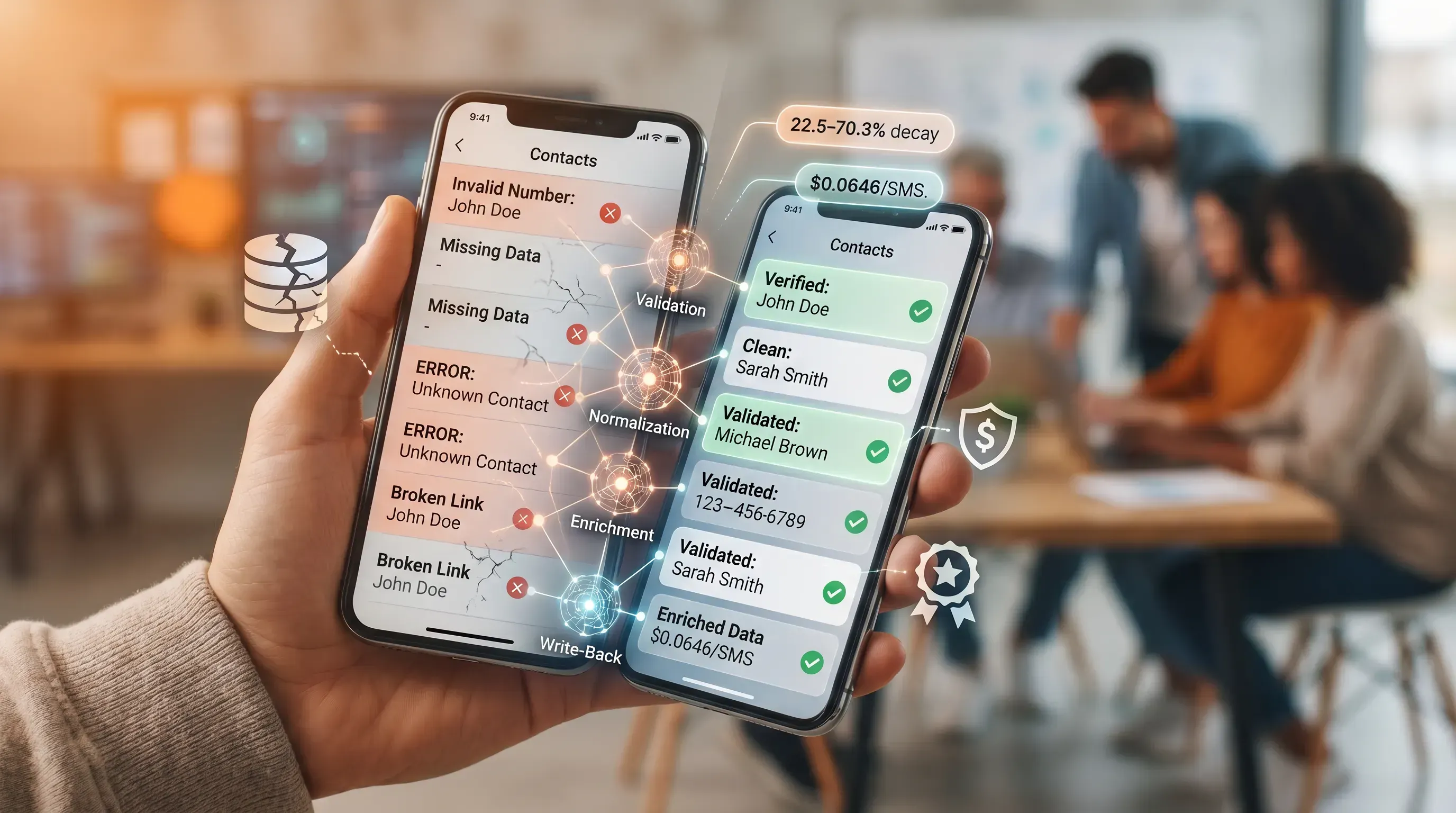
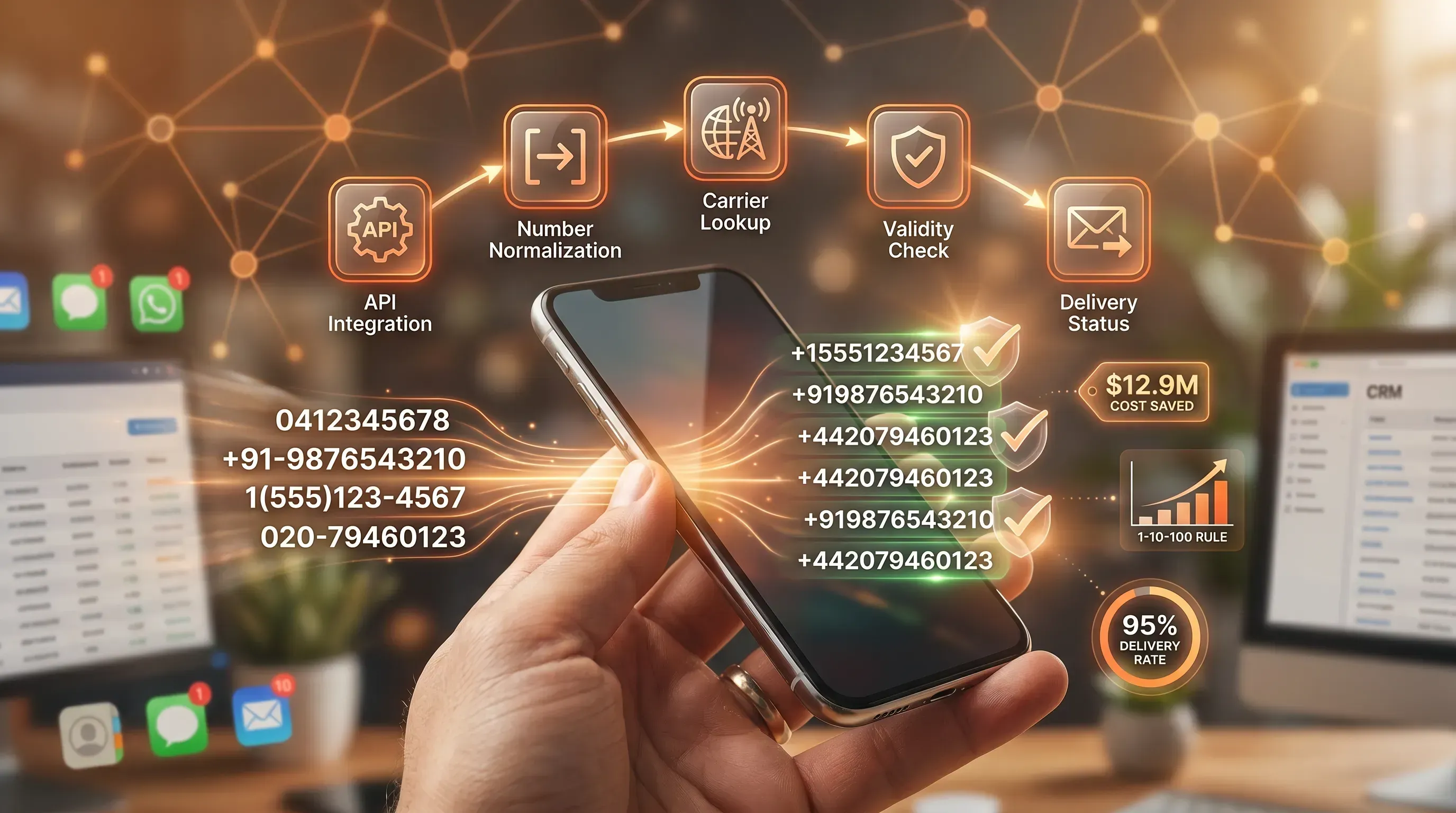
A realistic smartphone held in a hand displays raw mobile numbers transforming into validated contacts, set against a warm, blurred background.

This article explains how a mobile phone number validation API fits into the moment right before a message is sent. It walks through what a validation response tells you and where to trigger checks in CRM and ecommerce systems, then explains how to choose between real-time checks and batch jobs before evaluating a specialist provider.

Why bad numbers break messaging

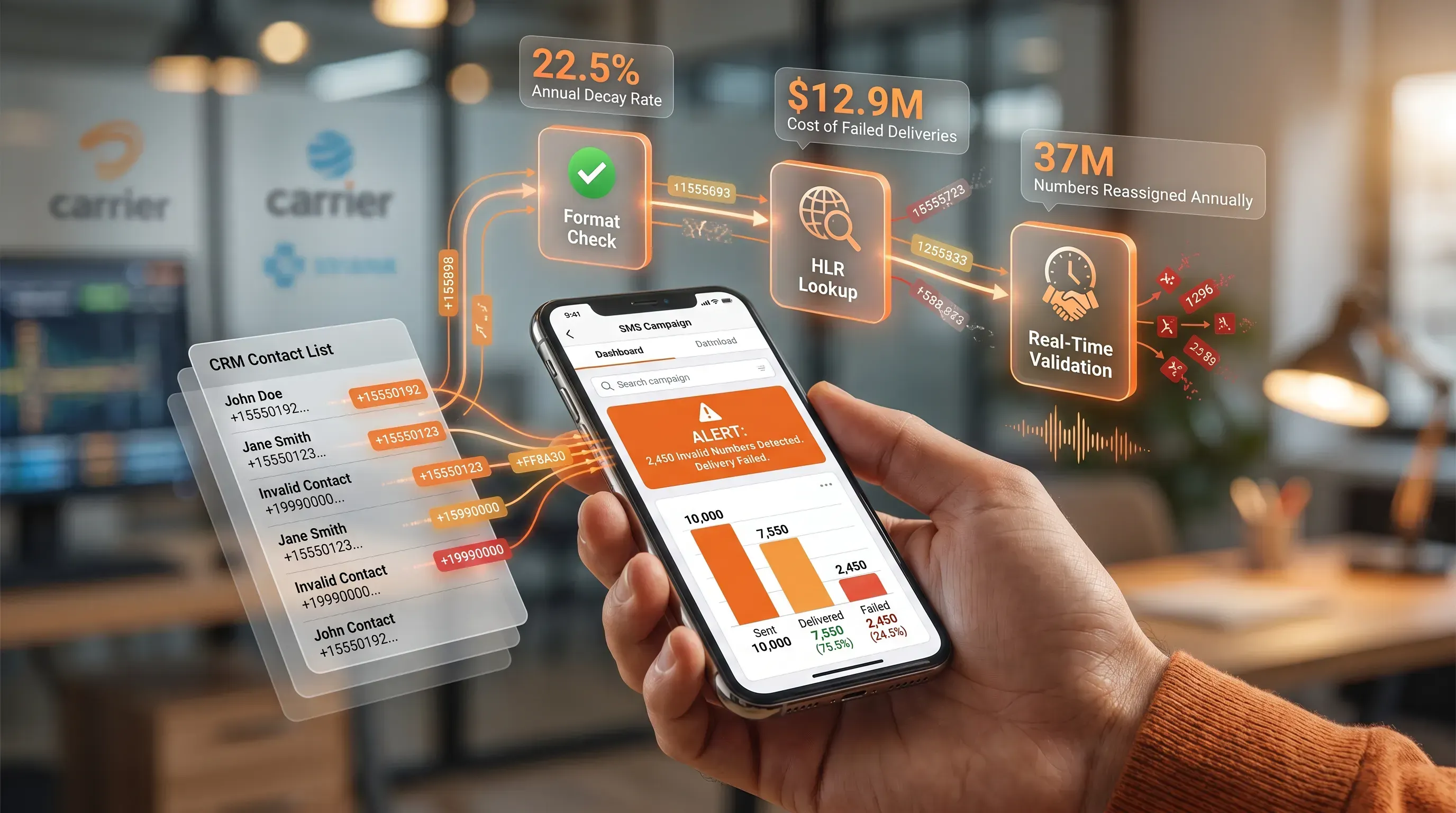
You push OTPs and campaign sends at scale, while alerts move through the same pipeline, and a measurable slice of those messages never lands. That slice is mobile phone number validation working against you in reverse. Some numbers are malformed. Others belong to landlines or route through Voice over Internet Protocol (VoIP) lines that can't take an SMS; some were disconnected months ago and nobody told your database. Every send against them costs money and pulls down the metrics you report on.

The damage compounds in three places. Marketing platforms count a "sent" status as success, but "sent" only means the message left your system for the carrier, which doesn't guarantee it reached a handset. A failed OTP in SMS verification blocks onboarding outright, because a user who can't receive the code can't finish signing up. And your customer records keep rotting in the background, with B2B contact data decaying around 22.5% per year as people change carriers and abandon numbers.

The cost isn't abstract. Poor data quality runs the average business around $12.9 million annually, per Gartner estimates. There's a well-worn principle in data management called the 1-10-100 rule: it costs about $1 to verify a record at the point of entry. After that, the cost rises to $10 to fix it once it's in the system, while doing nothing and acting on it anyway costs $100. The cheapest place to catch a bad number with mobile phone number validation is before the message is sent, because waiting until after the carrier rejects it means the credit is already burned.

Validation also improves contactability in OTP and SMS verification flows, but it is not a complete authentication-risk control. Where authentication risk is high, teams should layer in additional signals: SIM swap detection, device change flags, number porting history and abnormal behaviour patterns. SMS delivery is not a sufficient proof of identity.

How mobile phone number validation works

A validation API for mobile number validation does four things to a raw string before your pipeline trusts it. First, it normalizes the input to E.164, the international numbering standard defined by the ITU in which every number starts with a plus sign followed by the country code and subscriber number, capped at 15 digits. So a UK number entered as "07XXX XXXXXX" becomes "+447XXXXXXXXX" with the national trunk zero stripped. That single step removes most of the ambiguity in how people type numbers into a form.

Second, it confirms structural validity against the numbering plan for that country, which catches a number that has too many digits or sits in a range no carrier was ever assigned. Third, it detects line type and returns a result such as mobile or landline; the same field can also identify VoIP or toll-free numbers. Fourth, where the data is available, it checks live status against carrier records to see whether the number is actually connected.

Those last two layers are where engineers get tripped up, so it's worth separating what each one promises. Format validation is deterministic and cheap, but it only tells you a number is well-formed without confirming that it belongs to anyone. Line-type detection tells you whether the channel even supports SMS. True reachability, the question of whether the number is live on a network right now, comes from a different source entirely. The deepest version of that carrier lookup check is a Home Location Register (HLR) lookup, a real-time query against the operator database every carrier maintains about its own subscribers. The rest of this article builds on that distinction, because most bad messaging decisions come from treating a format pass as a reachability guarantee.

Validate every number. Deliver every message.

Talk to our team about real-time phone number validation, fraud prevention, and high-deliverability SMS for your business.

What a validation response tells you
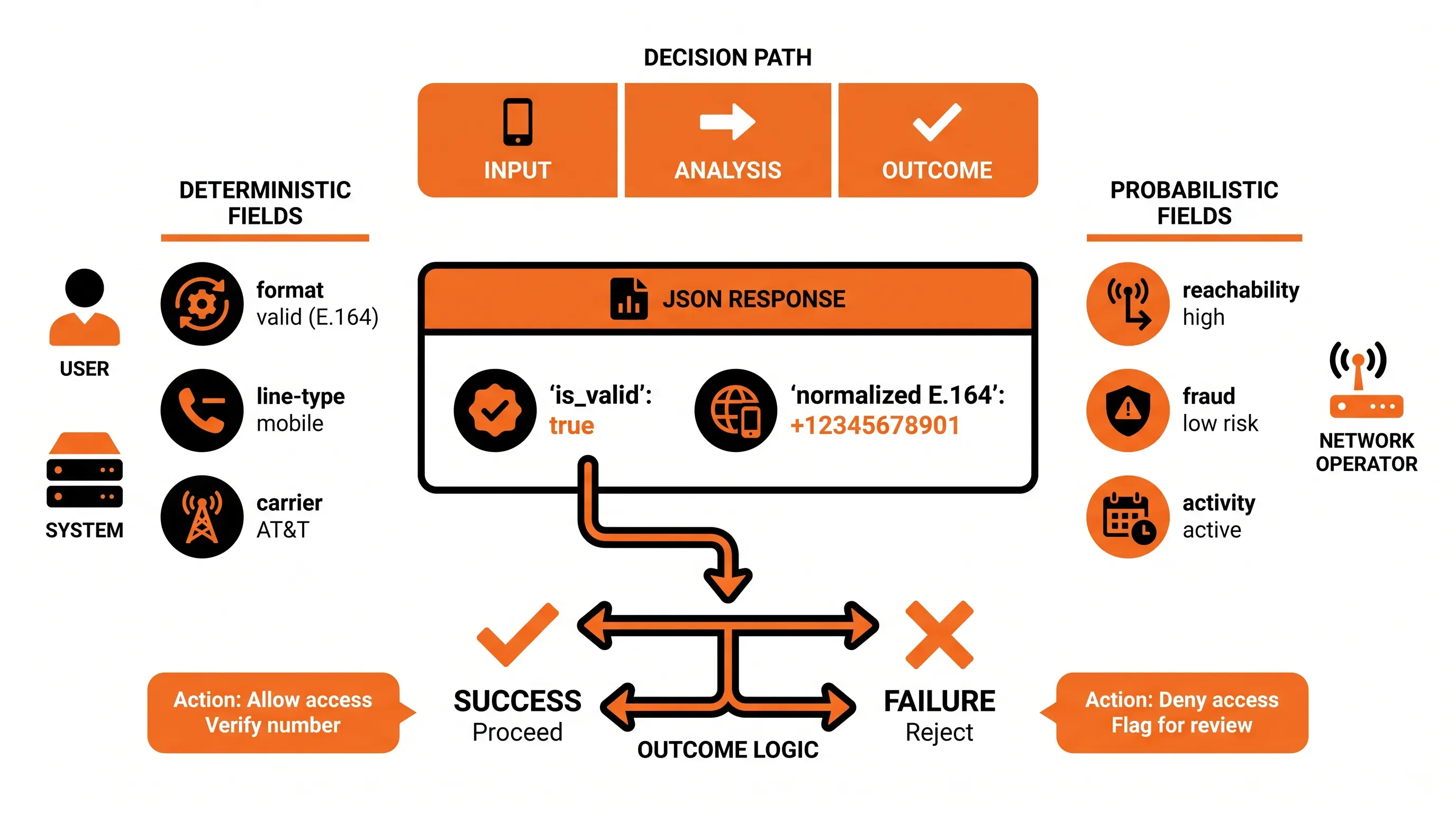
Bold flat infographic on a white background featuring a central JSON response card, deterministic and probabilistic fields clusters, and flow arrows.

Think of the mobile phone number validation response as a JSON object you'll branch logic on. Some fields are deterministic and you can trust them outright. Others are probabilistic or scored, and you need to know which is which before you wire a suppression rule around them.

Validity and format fields

These are the structural signals: an is_valid boolean and the normalized E.164 output, with the country code and national format handled as part of the same formatting layer. They're high-confidence and deterministic, which means they catch typos and malformed entries at the point of capture without any guesswork. If is_valid comes back false, the number was never going to work, and you can reject it at the form before it reaches storage.

The normalized output from phone number validation is the field that earns its keep over time. Rather than storing whatever the user typed, you write the E.164 string back to your database so every record follows one format. That standardization is what makes deduplication and downstream routing reliable for country-level segmentation, because the E.164 string is globally unique and carries the country code in a predictable place.

Line type and carrier lookup

Line-type detection returns whether a number is mobile or landline, and the same result can also surface VoIP or toll-free status; a carrier lookup identifies the network operator behind it. This matters before you send anything, because a landline can't receive an SMS no matter how clean the format is. If a number resolves to a landline, you route the customer to voice or email instead of burning an SMS credit on a guaranteed failure.

The carrier lookup also tells you when a number has been ported between networks, which the operator data exposes as a difference between the original and current network. And the line-type flag doubles as a fraud signal. VoIP and virtual numbers show up disproportionately in fake signups, so a VOIP_NUMBER_DETECTED result is a reasonable trigger during SMS verification to demand a second verification step before you let an account through. A carrier lookup that surfaces a disposable-number range is the kind of evidence you want before approving anything sensitive.

Reachability and activity signals

This is the higher-effort family: connected or disconnected status and activity scores drawn from live telco data. An HLR lookup determines whether a number is active on a network in real time and whether it's currently roaming. These signals cost more per check and take longer to return, because the request travels to the operator and waits for a response.

Be honest with yourself about what they promise. An active or assigned number confirms line existence on a network, while message readership remains outside the signal. Treat these as probabilistic and weight them accordingly: a disconnected status is a strong reason to hold or suppress a send, while an active status raises your confidence without ever reaching certainty. When the signal is ambiguous, the right move is to re-verify rather than to assume.

Triggering validation in your stack

Phone number validation earns its place at three points in the flow. The first is the point of capture, on signup and checkout forms, where a synchronous call against the entered number catches a typo while the user is still on the page and can correct it. The second is on record creation or update inside a CRM, so a number never reaches storage without being normalized first. The third is a gate immediately before a messaging job fires, where you validate the batch and drop anything unreachable before the send queue ever sees it.

How you call the API depends on your architecture, and there are two patterns worth matching to your setup:

  • Synchronous request-response works at capture, where latency is part of the user experience and you need the answer before the form submits. The SMS verification check returns in line, and your validation logic branches on it before the user moves forward or gets an error.

  • Webhook or event-driven triggers fit record updates and bulk jobs, where a CRM write or an ecommerce order event fires the validation in the background and your system reacts to the result without blocking anyone.

For teams running Shopify checkout flows or a Salesforce-style CRM, the integration point is the write path you already own. Acudo is available as an API or through the portal, so the call lives wherever a number enters or gets refreshed rather than as a separate manual step.

Validate every number. Deliver every message.

Talk to our team about real-time phone number validation, fraud prevention, and high-deliverability SMS for your business.

Real-time versus batch checks

These two modes solve different problems, so the choice between them is strategic. For mobile phone number validation, real-time validation protects the front door. It stops a bad number at entry, which keeps your database clean from the first write and gives the user a chance to fix a mistake immediately. The trade-off is latency: every check sits in the request path, so the provider's response time becomes part of your signup or checkout experience.

Batch validation cleans what's already there. You run legacy lead lists and aging CRM records through the API during off-peak windows, and the API flags disconnected and ported numbers in bulk. A specialist provider can process a list in hours rather than weeks, which makes a full-database pass practical on a schedule. This is how you fight decay on the records that entered before you had validation in place.

Most teams need both. Run real-time checks at capture to keep new data clean, then re-validate the full database on a periodic cycle to catch numbers that went stale after they were stored. To decide where to weight your effort, look at three things. High signup volume with low latency tolerance pushes you toward fast format checks at the front door, while large dormant lists and tight messaging budgets argue for aggressive batch reachability checks before any campaign. The cost per check sets how deep you can afford to go on each send.

Cleaner CRM and ecommerce data

Everything above ties back to outcomes you're accountable for. Fewer wasted sends means a higher delivery rate, and a delivery rate below 95% is a warning sign that your list is carrying invalid numbers. When you validate before write, the CRM stays accurate by default instead of degrading every quarter, which protects every downstream decision built on that data.

The line-type and reachability fields in mobile phone number validation do more than suppress failures. They let you route each customer to the channel most likely to reach them: SMS for confirmed mobiles, with landlines and unreachable numbers pushed to voice or email. That routing matters because the economics of SMS reward a clean list. SMS marketing returns between $21 and $41 for every dollar spent by conservative industry estimates, and every credit spent on a dead number is return you never collect.

The savings are real without needing inflated numbers to make the case. Removing undeliverable mobiles before a campaign cuts messaging spend directly and lifts the engagement metrics you report on because the denominator excludes numbers that could never respond; it also spares your sender reputation the carrier filtering that follows sends to dead ranges. Clean data in front of the pipeline is cheaper than dirty data behind it, which is the whole point of the 1-10-100 rule applied to messaging.

What to expect from a specialist provider

Hold a provider to a clear bar, and raise these criteria directly in the vendor conversation:

  • Data freshness and accuracy, with reachability data refreshed daily and reachability checks pulled live from operator records rather than a stale cache.

  • Country and carrier coverage, ideally 200 or more countries with direct operator connections where they exist.

  • Throughput and latency under load, with a published average response time, because a check that lags drags your whole signup flow with it.

  • Uptime backed by a service-level agreement, since a validation gate that goes down takes your messaging pipeline with it.

  • Documentation and SDKs clean enough to integrate in an afternoon, plus privacy-aware processing that doesn't retain your customer phone lists.

Low latency and high reliability matter most for SMS verification, the OTP and confirmation step that gates onboarding. A slow or flaky check leaves a user stuck on a screen unable to finish signing up, and every second of added latency costs you completed accounts. The same reliability standard applies to any SMS verification flow tied to a login or a payment.

Acudo brings the expertise of HLR Lookup, TPS Unlimited and e164 into one platform built for exactly this: confirming whether a number is real and reachable, with active status and correct formatting checked before budget is spent on it. It's a GSMA and ITU member with ISO 27001 accreditation, focused on mobile phone number validation rather than full Communications Platform as a Service (CPaaS) complexity. If you're deciding where validation belongs in front of your messaging pipeline, speak to Acudo about a validation workflow that fits your CRM and ecommerce stack.

Validate every number. Deliver every message.

Talk to our team about real-time phone number validation, fraud prevention, and high-deliverability SMS for your business.

Your system should fall back to a defined rule instead of failing unpredictably. For low-risk marketing, you can hold the send and retry later. For OTP or payment flows, decide whether to allow a limited retry path, use email verification, or show a clear error message.

Revalidate active customer numbers before major SMS sends and on a set cycle for stored records. A practical starting point is monthly or quarterly, then adjust based on bounce rates, signup volume, and message cost. Mobile phone number validation works best when stale records are checked before they enter a campaign queue.

Yes, you can design validation so the provider checks numbers for the request and returns structured results without keeping your customer list. Confirm retention terms, encryption, regional processing, and audit controls before integration. Speak to Acudo about mobile validation workflows if you need this mapped to CRM or ecommerce data flows.

Block the action only when the failure is certain, such as an invalid format or a confirmed landline for SMS. If the result is ambiguous, ask the user to re-enter the number or offer another verification channel. This avoids rejecting valid customers because of a temporary lookup issue.

Treat validation results as a separate data layer from delivery results. Report the count of numbers suppressed before sending, then compare spend and delivery rates against campaigns that weren't filtered. Keep OTP failures separate from marketing failures because the operational impact is different.

Get in touch

Talk to our team about phone number validation, fraud prevention, and reliable SMS communications.

You Might Also Like

Discover more insights and articles

A human hand holds a glossy smartphone, showcasing a contact list transforming from messy to clean entries against a warm bokeh background.

Customer Phone Number Cleansing for Better SMS Campaign Readiness

This article explains customer database cleansing and shows how a practical pre-send cleanse protects SMS delivery and budget before a large campaign or seasonal peak.

A hand holds a glossy smartphone displaying a dynamic CRM interface, surrounded by organized contact nodes and metrics in a warm office setting.

Customer Data Cleansing: Keep Contact Records Accurate Before You Message

This article treats customer data cleansing as an ongoing maintenance cycle that explains contact record decay and builds a repeatable routine around its costs so your messages keep reaching real people.

A realistic tech scene featuring a smartphone displaying an SMS campaign dashboard, with glowing validation nodes and a CRM contact list overlay.

CRM Phone Data Quality: Why Customer Phone Numbers Matter Before You Send

This article explains why CRM data quality shows up first in the phone number field and how that quiet decay drags down your SMS results. It also explains what to do about it. You will finish able to diagnose whether your own contact data is costing you reach and money through weaker delivery, and to make the case for fixing it.

A realistic hand holds a smartphone, surrounded by warm bokeh, with data icons streaming in and glowing contact nodes on the side.

Customer Phone Data Cleaning for More Reliable SMS Communication

This article explains why customer data cleaning is the real fix behind reliable SMS for order alerts and delivery updates. It walks through the data faults that make contact records go stale and break message delivery, then shows what a practical pre-send validation process looks like for ecommerce and operations teams.

Get in touch

Talk to our experts about validating phone numbers and delivering business-critical SMS with reliability and speed.

Close