Understanding phone number data for customer outreach

Content authorBy Claire ConnorPublished onReading time12 min read
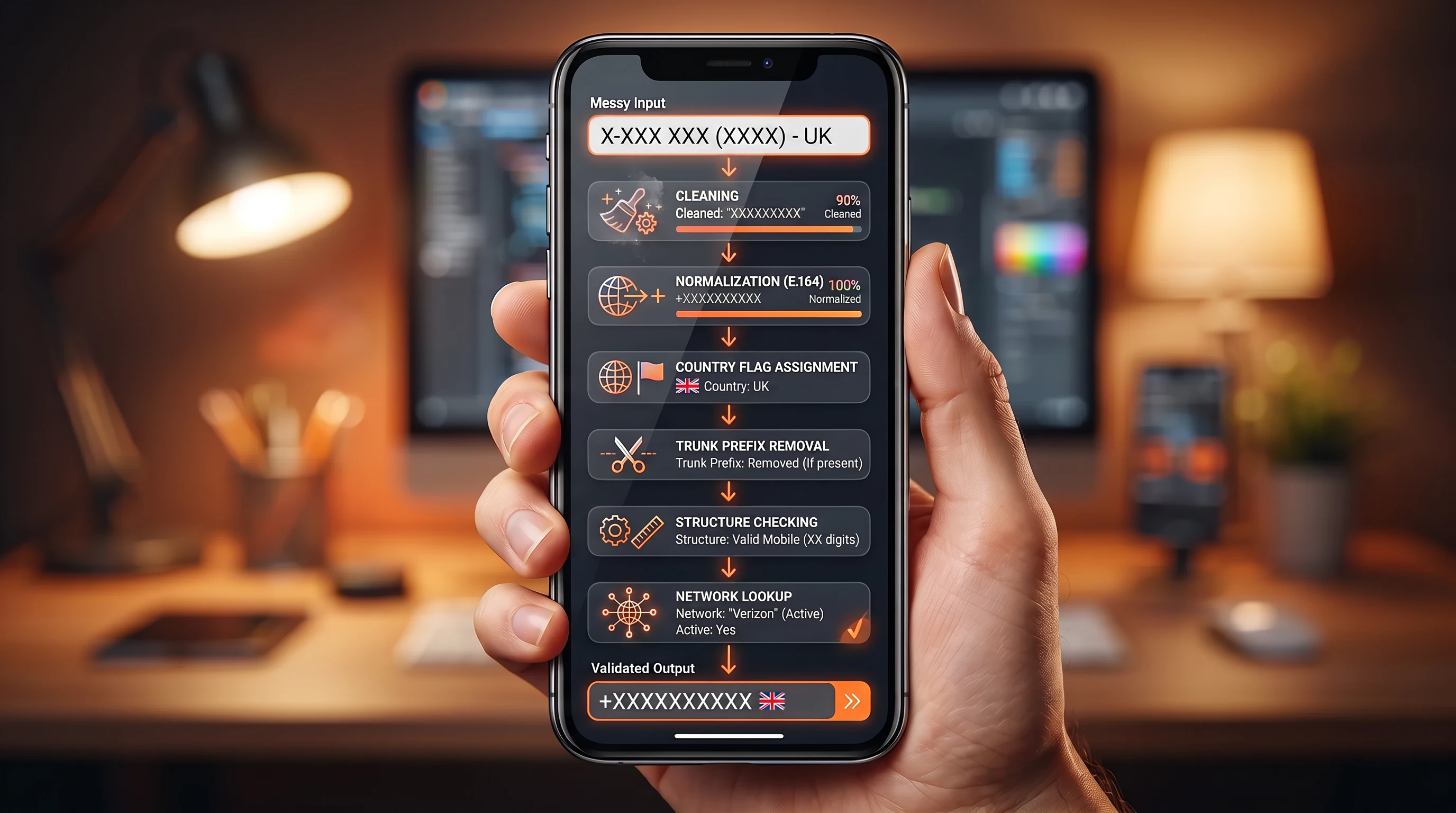
A realistic hand holds a smartphone displaying a glowing network map, surrounded by icons and a warm, blurred bokeh background.

Phone number data carries attributes that shape calling and messaging decisions, and even a careful cleanup leaves records that go stale over time. A layered validation workflow addresses this directly.

Why the number alone tells you almost nothing

Phone number data consists of the attributes attached to the number your team stored. A record in your customer relationship management (CRM) system reads as a clean ten digits while routing to a disconnected line. The same clean digits also belong to landlines that can't receive a text or people who moved carriers last year.

That gap is the practical problem for anyone running calls or SMS campaigns from a contact database. You can see a number, but you cannot tell whether it is safe to place into a workflow. Its reachability and classification remain hidden.

What phone number data means

Think of phone number data as structured intelligence about a number. A useful record describes the line's technical type and current network status. It also identifies the carrier and geographic context. The record provides a standardized representation of the digits and the recipient's likely local time. Each of those is a separate fact, and each answers a different operational question.

What this intelligence does not do is prove who owns the line. A validated number tells you the line exists and how it behaves on the network. It says nothing about identity or consent. Nor does it predict whether the person will answer. Treating a clean validation result as permission to contact someone is where teams get into trouble, because those are separate questions answered by separate records.

So the value here is decision support. Good phone number data narrows your choices before you spend money on a channel. It helps you route a message correctly and schedule it sensibly. But its role is operational; legal clearance comes from elsewhere.

Attributes behind each record

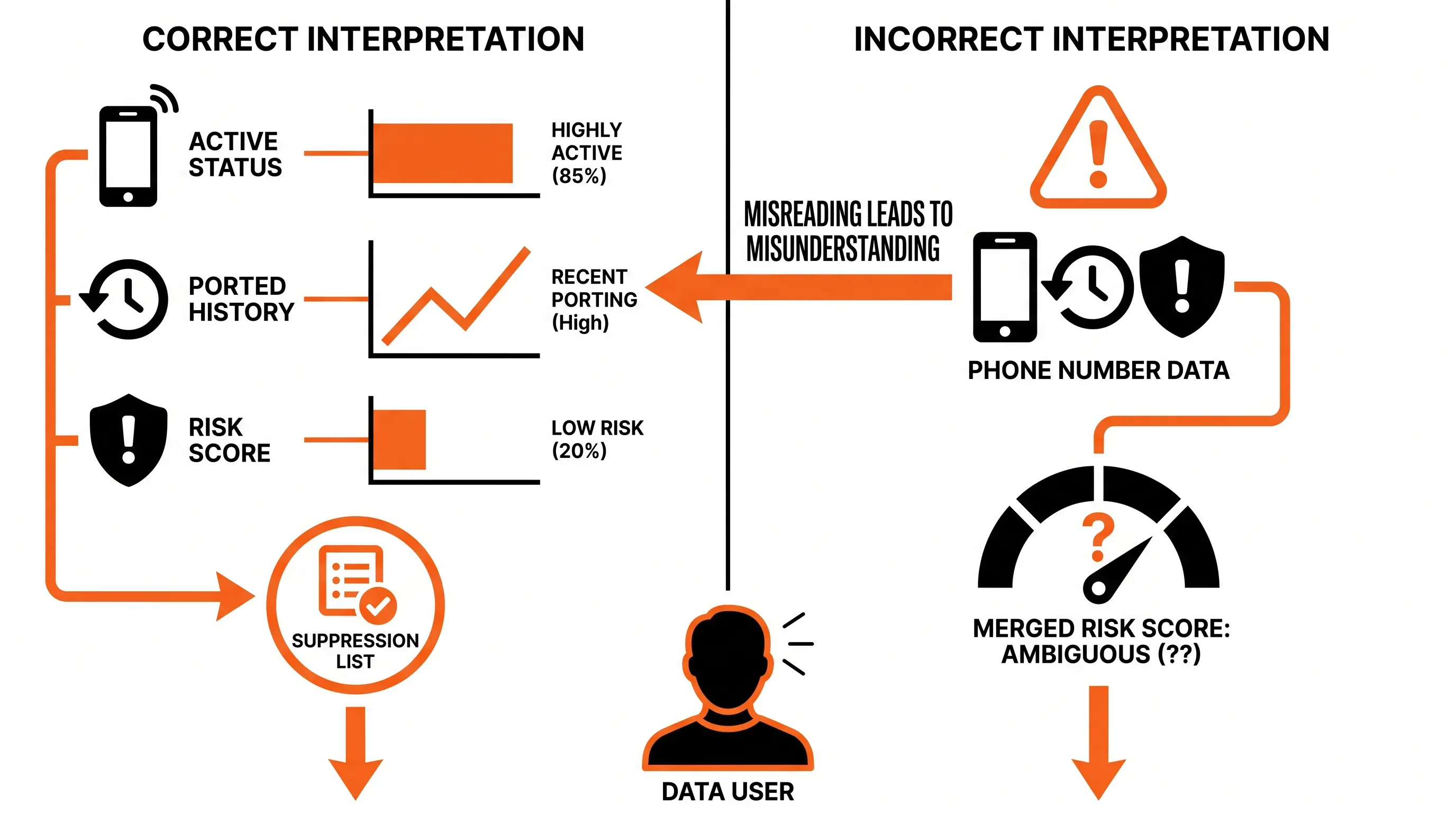
Bold infographic contrasting 'Correct Interpretation' and 'Incorrect Interpretation' panels with icons, charts, and a central data user icon.

When you enrich phone number data, you get back a cluster of fields, and the mistake is reading them as one combined valid-or-invalid score. They aren't. A number can be perfectly formatted and completely disconnected. It can be a real mobile line and still sit on a national suppression list.

Here is a sample of what an enriched record can contain, with values used only as illustration:

  • Line type: mobile, landline, VoIP, or toll-free

  • Status: active, inactive, or disconnected where the network supports it

  • Carrier and any ported-number indicator

  • Country, region, and a standardized E.164 representation

  • Time zone and UTC offset

Field availability changes from country to country and network to network, so no provider returns every attribute with equal precision everywhere. The sections below take the fields that matter most and explain the question each one answers.

Line type and status

Line type distinguishes mobile and landline numbers. It also identifies VoIP and toll-free numbers. That classification decides your channel before anything else does. A mobile line is a candidate for SMS and for quicker, more conversational outreach. A landline can't receive a text at all. Toll-free and VoIP numbers need different handling because they route differently and reach different respondents.

Status is a separate signal that sits on top of line type. Where the network supports it, status identifies whether a number is active right now. It also distinguishes inactivity from disconnection. An HLR lookup queries the subscriber database that mobile operators keep, and it returns connectivity and network information for a GSM number in real time. That's the difference between knowing a number is shaped like a mobile and knowing the line is live today.

Neither field grants permission. A technically valid format and an assigned, active line still don't confirm that the person on the other end uses the number or agreed to hear from you. Line type and status shape how you reach someone. They don't decide whether you're allowed to.

Validate every number. Deliver every message.

Talk to our team about real-time phone number validation, fraud prevention, and high-deliverability SMS for your business.

Carrier and porting

Carrier data identifies the network a number sits on today. That matters for routing and confirming line type. It also helps you decide when a record needs another look. Since UK consumers made 4.1 million mobile switches in the first 12 months after Ofcom introduced text-to-switch, a 15% year-on-year increase, carrier information ages faster than most teams assume.

Porting is the reason. When someone keeps their number and changes networks, the original carrier record you stored becomes wrong while the digits stay the same. A ported-number indicator flags that the line has moved, and a live lookup can also detect whether the number is currently roaming. Coverage of porting history varies by market, so treat this as a signal your provider supports to the extent the local network allows.

A carrier match tells you where the line lives now, which helps you route correctly and decide when to revalidate. Reading matched carrier information in phone number data as a green light to send is a different claim, and the data doesn't support it.

Country and formatting

Every number carries a country code and a country or region. It also has a preferred written form. The standard worth normalising to is E.164, the ITU-T numbering plan that limits a full international number to fifteen digits: a country code of one to three digits followed by the national number. Store numbers this way and they become unambiguous without any surrounding context.

The catch shows up when people enter numbers in national format. To resolve those correctly, a parser needs a default region, because the same string of digits can be a valid number in more than one country. Raw pattern matching won't settle it on its own. Google's open-source libphonenumber requires a default region whenever a number isn't already in international format, precisely because a regular expression can't guess where an ambiguous entry belongs.

Standardization pays off in three places. It lets you deduplicate reliably, because the same person entered as "J. Doe" with a local number matches the international version. It routes messages correctly. And it points you at the right jurisdictional checks for the number's actual country.

Time zone and offset

Time zone and UTC offset tell you the recipient's likely local hours, with daylight saving time shifting the offset for part of the year. Use these fields to schedule calls and messages inside sensible windows and to avoid the obvious mistimed contact, like a 3 a.m. alert to a number three zones away from your operations center.

Number-based location is imperfect, though. People travel or keep their numbers after moving across the country. Non-geographic VoIP services also reveal nothing about where users actually are. Use the offset as a scheduling signal that does not imply a live location. Lean on it to set dialing windows, and don't mistake it for knowing where the person sits at this moment.

How data shapes outreach

Once you read the attributes as separate signals, the campaign decisions get simpler. Line type decides call versus text. Region points you at the right compliance checks. Status and porting tell you which records to route differently or flag for another look before you commit spend.

Suppression is where several signals meet. A number can be a live mobile and still be off-limits because it appears on the Telephone Preference Service (TPS) register. The same restriction applies when it appears on your internal suppression list or when your consent records don't cover the campaign. In the UK, once a number is registered with the TPS it stays registered indefinitely, and organisations must screen against the register at least every 28 days, since a number can register after your last check. Unlike the US, there's no equivalent UK public database for checking whether a number has been reassigned to a new subscriber since consent was collected. The gap has to be managed through your own consent records and periodic re-verification instead. Those are the screens that decide whether a technically reachable number is one you should actually contact.

The boundary has to stay explicit. Phone number data helps you apply your compliance rules, and it does a lot of the operational work of finding which numbers to review. But documented consent and a current suppression check remain separate requirements. Legal advice for the jurisdiction you're contacting also remains separate from number intelligence. The data tells you how a line behaves while your compliance program decides what you're permitted to do with it.

Validate every number. Deliver every message.

Talk to our team about real-time phone number validation, fraud prevention, and high-deliverability SMS for your business.

Why phone records decay

A clean record starts going wrong the day after you clean it because the world keeps moving. People change or give up numbers. Other numbers get disconnected and reassigned. Carriers change through porting. Employees leave the companies whose direct lines you stored. B2B contact data decays at roughly 22.5% per year, which is close to a quarter of your records aging out annually.

Phone number data fields sit near the front of that decay. The same research puts phone number invalidation at 42.9% within a single year, driven partly by the roughly 30% of employees who switch jobs each year. So the direct line that reached a decision-maker in January is a dead end by autumn, and nothing in the stored digits warns you.

Operational decay stacks on top of that natural churn:

  • Imports and free-text entry introduce missing digits and impossible structures

  • Inconsistent country codes break routing and hide the number's real jurisdiction

  • Duplicate and shared records point multiple entries at the same person

When the same contact lives in your CRM three times, they get the same message three times, which reads as spam to them and inflates your spend for you. Invalid or badly formatted entries drain dial time and burn SMS budget on lines that were never going to answer, since most providers bill on submission, regardless of whether delivery is confirmed. Since decay is continuous, a one-time cleanup is aging before the export finishes.

A layered validation workflow

The fix is a recurring sequence that catches obvious errors early and enriches records with current network intelligence. It then revisits the phone number data as it ages. Some checks assess syntax or the shape of the number. Others assess telecommunications or suppression data to determine what the number does on the network and whether you're cleared to use it. Keep those layers distinct, because passing one says nothing about the others.

One habit makes the whole workflow auditable: store the validation result with its source on every record. Add a timestamp as well. That way a campaign team can judge freshness for themselves instead of trusting an unexplained valid flag.

Check data at entry

Start at the point of capture, with country-aware parsing. Add length and prefix rules, then run these format checks on forms and imports. Apply them again during CRM updates to catch errors before they spread through your database. This is where you catch missing digits and impossible structures. Inconsistent representations are also corrected before they multiply across duplicated records.

What entry checks confirm is plausibility, and nothing more. A number can pass every syntax rule and still be disconnected or non-mobile. It can also remain unapproved for outreach. Format validation alone catches roughly 70 to 80 per cent of bad numbers, the cheap and obvious ones, which is real value at the door and also the reason you can't stop there.

Run network lookups

The next layer queries the network. A carrier or HLR lookup can return current status and carrier where the market supports those fields. It can also identify line type, along with roaming or porting indicators. This is what separates a number that's shaped like a live mobile from one that actually is.

Suppression screening is a separate step because network lookups do not cover it. Where your campaign and jurisdiction require it, run Do Not Call and internal suppression checks alongside the network query rather than assuming one includes the other. And distinguish a definitive result from an unknown or unavailable one. A lookup that returns "no data" is not the same as a confirmed active line, and no provider covers every network on earth with equal depth.

Revalidate valuable segments

Re-cleaning your entire database on a loop wastes effort on records nobody's about to contact. Instead, prioritize: recurring verification belongs on high-value and high-volume segments. It also belongs on recently inactive records and any list heading into a campaign. Real-time API checks handle new and changed records at the moment they enter, while batch validation refreshes the existing lists you already hold.

Event-based triggers keep the cadence honest without over-processing:

  1. A failed call or a bounced message on a record you thought was good

  2. A returning customer whose details need a fresh look

  3. A major import or an upcoming campaign that raises the cost of stale data

Whatever the trigger, keep the latest verification date on the record. When a dispute or an audit lands, that timestamp is the difference between showing your work and guessing.

Acudo as the data source

Acudo supplies phone number validation and enrichment through real-time API checks and bulk data uploads. Its service draws on the technology behind HLR Lookup, TPS Unlimited and e164. Use Acudo at capture to catch mistyped and impossible numbers, during CRM cleanup, and before a campaign to refresh the segment you're about to spend on. This helps calls and texts reach real lines with current classifications and phone number data. Speak to Acudo about the attributes and market coverage you need.

Validate every number. Deliver every message.

Talk to our team about real-time phone number validation, fraud prevention, and high-deliverability SMS for your business.

Yes. A number can have valid formatting yet belong to a landline, a disconnected line, or a recipient on a suppression list. Check line type and current network status before selecting SMS. Review consent and suppression records separately, because technical validity doesn't authorize contact.

Refresh records before campaigns and after a failed call or bounced message. Give high-value segments a shorter review cycle than inactive contacts, since reassignment and carrier changes make stored results less reliable over time. Keep the lookup date and source on each record.

Treat a no-data result as unknown, not as an active or inactive classification. Network coverage and returned fields differ by country and carrier. Hold the record for review, use another permitted verification method, or exclude it from the campaign until its status is confirmed.

A local number doesn't always identify its country by itself. The same digits can fit numbering rules in more than one place, so a parser needs a default country to convert the entry into E.164 format. Ask for country selection at entry when international context is absent.

Acudo can check phone number data at form entry, during CRM cleanup, and before an outreach campaign. Its API and bulk processes can return supported formatting, line-type, carrier, and status information. Speak to Acudo about mobile validation workflows and confirm coverage for your target countries.

Get in touch

Talk to our team about phone number validation, fraud prevention, and reliable SMS communications.

You Might Also Like

Discover more insights and articles

Title:
How to create phone number validator rules that catch common errors

Meta description:
Learn how a phone number validator lets you clean input and check whether numbers can receive messages.

A

How to create phone number validator rules that catch common errors

Turning messy phone input into stored numbers you can actually message means building a validation pipeline, not a single regex. From cleaning through to a live network lookup, then what to return to the caller and how to test the whole thing end to end.

A realistic smartphone in a hand displays a phone number entry UI, glowing network overlay, and a secure checkmark, with warm bokeh background.

Phone verification for trust & safety teams

Fake accounts are rarely stopped by adding another verification step. The better approach is to use phone intelligence to decide which signups need more friction and which can pass with minimal interruption.

For trust & safety teams, the goal is not to verify every phone number in the same way. It is to identify numbers that look risky, validate legitimate ones quickly, and reserve stronger verification for accounts that show other signs of abuse.

A close-up of a realistic hand holding a smartphone displaying a UK phone number signup interface with a glowing network overlay.

How to set up UK phone number verification

A UK mobile number can look perfectly valid and still be unsuitable for an OTP, onboarding check, or critical customer message. The problem is what happens between accepting the number and sending the message: format validation can confirm that the number follows UK numbering rules, but it cannot tell you everything about the line itself. A stronger verification flow puts number validation and intelligence before the OTP send, so product, engineering, and trust & safety teams can make a better decision about whether to proceed.

A realistic hand holds a glossy smartphone displaying an SMS campaign dashboard, with glowing network icons and warm bokeh background.

How to build a bulk SMS messaging campaign that drives results

A first bulk SMS messaging campaign either sets the pattern for every one that follows, or teaches an expensive lesson in consent and list hygiene before a single message goes out. Getting it right comes down to sequence: one measurable goal, defensible consent, a validated list, and a message worth reading, built on the UK rules that decide whether a text lands or gets filtered.